
The free period calculator is a simple, private online tool that predicts your next period date, ovulation day, and fertile window in seconds. On this page, we explain who built it, why it exists, and how you can get the most accurate cycle predictions from it.
Who We Are
Free Period Calculator is a small independent team of developers and health-writers who care deeply about accurate, accessible cycle health. We noticed that most period tracking apps are expensive, store your data on commercial servers, and lock useful features behind subscriptions. We wanted to build the opposite: a free, private, browser-based tool that anyone can use without an account.
Our team comes from backgrounds in software, biology, and women’s health content. That mix means we obsess over both the accuracy of the calculation and the clarity of the advice, so every woman can trust what she sees on screen.
Our Mission
Our mission is to make accurate cycle tracking available to every woman, everywhere, at zero cost. We believe knowing your own body is a basic right, not a premium feature. Every calculation on this site happens inside your browser, and we never store, sell, or share your dates or symptoms.
Beyond the tool, we produce clear, practical guides on topics like cycle length, ovulation, and common period concerns. If you want to learn more while you use the calculator, our free online blog is a good place to start.
What Our Free Period Calculator Offers
- Next Period Prediction: Get your next period start and end date instantly.
- Ovulation Day: See your most likely day of ovulation each month.
- Fertile Window: Know the days pregnancy is most possible.
- Three-Month Forecast: View your next three predicted cycles at once.
- PDF Report: Download a clean summary of your cycle data.
These features work together to help you plan trips, workouts, appointments, or family planning with confidence. For a deeper explanation of the calculations, read our period calculator guide.
How Our Free Period Calculator Works
The free period calculator uses three basic inputs: the first day of your last period, your average cycle length, and how long your period lasts. It starts with the standard 28-day cycle as the baseline and adjusts every prediction to your personal numbers.
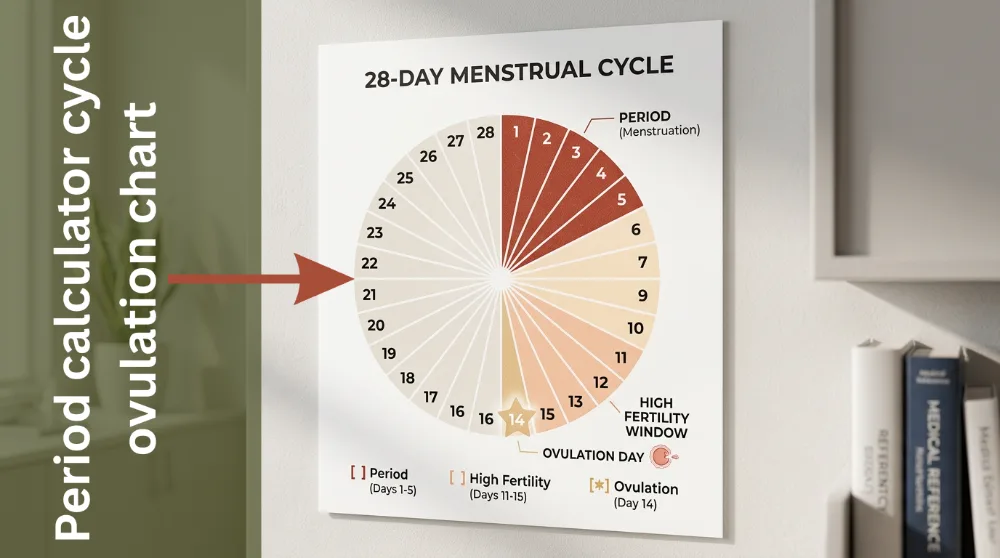
Ovulation is estimated about 14 days before your predicted next period, and your fertile window is counted as the five days before ovulation plus ovulation day itself. The math is simple, but it is based on the standard menstrual biology that health authorities like the American College of Obstetricians and Gynecologists describe.
Why Choose Free Period Calculator
There are a few reasons women keep coming back to this free period calculator. It is completely free with no hidden upgrades, it runs entirely in your browser so nothing is saved on our servers, and the results are updated instantly as you adjust your cycle length. That combination is rare in the period tracking world.
It is also designed to be simple. You do not need to build a month of data before your first use, and you can bookmark the page and run it once a month in under a minute. For anyone starting to track their cycle for the first time, or for a global period user who needs predictions across time zones, the global period calculator is a helpful companion.
Frequently Asked Questions
Is the free period calculator really free?
Yes. Every feature, including the PDF report, is available at no cost. You never have to subscribe, upgrade, or enter payment details.
Do you store my period data?
No. Everything is calculated inside your browser, and our team never collects, stores, or shares your dates, symptoms, or results.
What if my cycle is irregular?
The free period calculator still works, but predictions are less exact for irregular cycles. Log several months to improve accuracy, and treat results as a guide rather than a guarantee. For trusted detail on why cycles vary, the NHS guidance on periods is reliable.
Can I advertise or work with you?
We welcome partnerships with authentic health and wellness brands. Reach out through our contact page and we would be glad to discuss opportunities.
Who Is the Free Period Calculator For?
The free period calculator is for anyone who wants a clearer picture of their menstrual cycle. You do not need to be a health expert or a dedicated journaler. The tool is equally useful for a teenager logging her very first period, a woman trying to understand irregular cycles, and a couple trying to time conception around ovulation.
It is also a great option for the millions of women who prefer not to hand their sensitive cycle data to a commercial app. Because everything runs in your browser, you get all the prediction power of a premium tracker without surrendering your privacy.

Our Core Values
Accuracy. We built the free period calculator around the accepted menstrual-cycle math, and we update it whenever we find a way to make predictions clearer or closer to reality. We never use clickbaits or inflated claims about what a calculator can do.
Privacy. Your dates and symptoms belong to you. The free period calculator never sends them to a server, which is why we can honestly say we do not store or share your data. There is no account, no tracking pixel on the tool, and no hidden data collection.
Accessibility. Cycle health should never be paywalled. Every feature of the free period calculator is available at no cost, forever. We believe that when a woman understands her cycle, she makes better decisions about her health and her life.
Understanding Your Menstrual Cycle
A menstrual cycle counts from the first day of one period to the first day of the next. The average cycle is 28 days, but it is completely normal to have a cycle anywhere between 21 and 35 days. Your period itself usually lasts between three and seven days, with five days being the average.
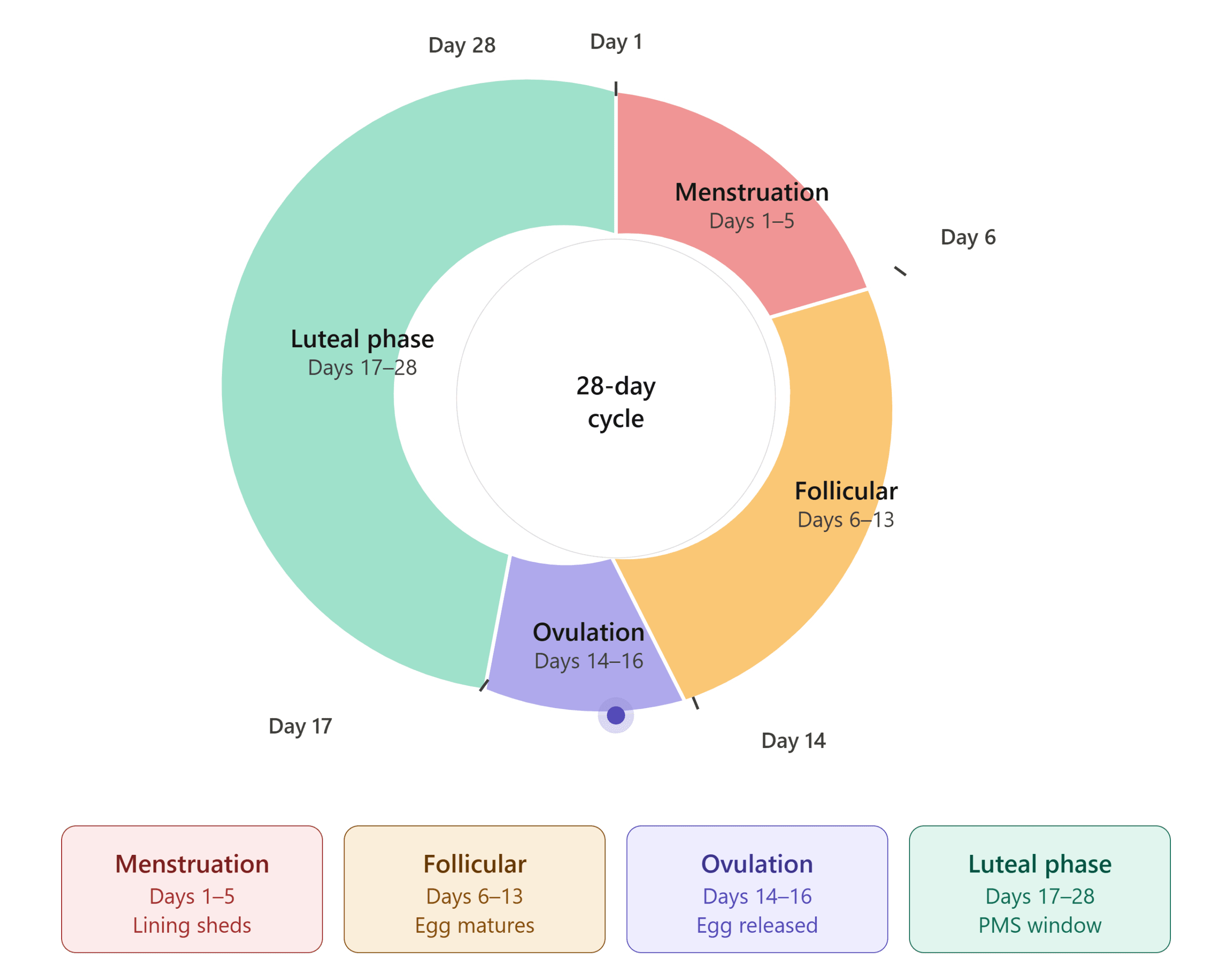
Within each cycle, your body moves through four phases: menstruation, the follicular phase, ovulation, and the luteal phase. During menstruation, the lining of your uterus is shed. In the follicular phase, eggs begin to mature. At ovulation, usually about 14 days before your next period, an egg is released. Finally, the luteal phase prepares the uterus for a possible pregnancy.
Tracking these phases is exactly what our free period calculator helps you do. By logging your start date, cycle length, and period length, you can see where you are in this cycle at any moment, which is incredibly useful for planning and for noticing when something feels different than usual.
The Science Behind Our Predictions
The predictions you get from the free period calculator are based on the standard calendar method, which has been used by women for decades. The key assumption is that ovulation happens about 14 days before your next period begins. From your cycle length, the tool counts forward from your last period start date to estimate the next start date, then works backward to estimate ovulation.
Your fertile window is then calculated as the five days before ovulation plus ovulation day itself. Sperm can survive inside the body for up to five days, which is why those earlier days count. This is the same logic used by many medical professionals when explaining natural family planning, and it is why the results feel consistent month after month.
No tool can predict your exact biology with certainty, especially if your cycle varies. That is why we encourage you to treat the free period calculator as an accurate planning guide and to combine it with your own observations and, when needed, professional advice. For a deeper look at the biology, the ACOG menstrual cycle guide is an excellent resource.
How We Keep Our Content Accurate
Health information should be trustworthy, and we take that responsibility seriously. Our articles are written by writers who research menstrual health carefully, and they are checked against reputable sources such as the American College of Obstetricians and Gynecologists, the NHS, and the Mayo Clinic before publication.
When medical guidance changes, we update our content to match. We also correct errors quickly when readers point them out, because accuracy is the whole point of a free period calculator and the guides that support it. If you ever see something that looks wrong, please let us know through our contact page.
Frequently Asked Questions
How long should I track before trusting the predictions?
You can use the free period calculator immediately with just your last period date. For the most accurate results, track at least three or four cycles so you know your average cycle length from your own data.
Can the calculator predict pregnancy or ovulation for family planning?
It can estimate your fertile window and ovulation day, which is useful for planning. It is not a contraceptive method, so always use a medically approved method if you are avoiding pregnancy.
Does the free period calculator work on a phone?
Yes. The tool runs in any modern browser, so it works on phones, tablets, and laptops without downloading anything or creating an account.
Will you ever charge for the calculator?
No. The free period calculator will stay free. Our goal is to make accurate cycle tracking accessible to everyone, and that is a promise we are committed to keeping.
How to Get the Most from the Free Period Calculator
To get the best results, bookmark the homepage and update the calculator at the start of every period. Keep your average cycle length in mind, and use the preview tab to see your next three predicted cycles at a glance. Download the PDF report if you want to keep a printable record of your dates.
Read one or two blog articles each month to understand what is normal and what is worth mentioning to a doctor. Combining a free period calculator with good information is the most practical way to stay on top of your cycle health without stress.
A Short History of Our Free Period Calculator
Free Period Calculator began as a simple idea: cycle tracking should not require an expensive app, a sign-up, or a data grab. We watched too many women give their intimate cycle details to apps that stored and resold that information, and too many free tools that quietly stopped being free. So we built our own.
The first version was a basic script that counted days and returned a next-period date. Feedback from early users quickly shaped what you see today: a fully visual preview tab, three-cycle forecasts, symptom tracking, a phase indicator, and a printable PDF report. Every feature was added because someone asked for it.
Today, the free period calculator serves thousands of visitors every month. We keep it independent, private, and free, and we plan to keep it that way. Our roadmap includes more languages, more educational content, and deeper cycle analytics for those who want them.
Our Editorial Standards
Everything published by the free period calculator follows three rules. First, it must be accurate: we cite reputable medical sources and correct mistakes quickly. Second, it must be honest: we never promise certainty that a calculator cannot deliver, especially for irregular cycles. Third, it must be useful: every article should answer a real question a woman actually has.
We also keep advertising clearly separate from editorial content, and we never accept payment in exchange for a review or a ranking change. This keeps the free period calculator and its blog a source you can trust.
Glossary of Common Cycle Terms
Understanding a few key terms makes it much easier to read your results and our articles. Here are the words you will see most often when using the free period calculator.
Menstrual cycle: the time from the first day of one period to the first day of the next, usually 21 to 35 days. Menstruation: the phase when your uterus lining is shed, commonly called your period. Follicular phase: the days after your period when eggs mature in the ovaries. Ovulation: the moment an egg is released, typically around 14 days before your next period. Luteal phase: the days after ovulation when the body prepares the uterus for pregnancy. Fertile window: the five days before ovulation plus ovulation day, when pregnancy is most likely. Cycle length: the number of days from the start of one period to the start of the next.
Knowing these terms helps you talk about your cycle with confidence, whether you are chatting with a doctor, reading our guides, or explaining your results to a partner. You can bookmark this section and come back anytime.
Get Started Today
Thank you for trusting freeperiodcalculator.com as your cycle-health companion. If we never read otherwise, we build for you: private, accurate, and free. Open the free period calculator now, and if you have questions, our blog and contact page are always here to help.