
Popular options used by millions of American women include apps like Flo, Clue, and Glow, but always verify the privacy settings before you start logging personal health data.
Whatever you pick, the habit matters more than the app. The best period calculator on the internet is useless if you forget to log your start dates, and the simplest notebook changes your health if you use it every month.
The good news is that you don’t need to pay for anything to get started. This page’s free period calculator handles the core predictions instantly, and a plain notebook or the notes app on your phone is more than enough to track the dates. Fancy features are nice, but consistent, accurate input beats any expensive subscription.
Common Myths About Period Calculators
Myth #1: All cycles are 28 days. False. The 28-day average is just that — an average. Healthy cycles range from 21 to 35 days.
Myth #2: A period calculator can replace birth control. Absolutely not. These tools track fertility windows but are not medically approved as contraception.
Myth #3: Irregular periods mean something is seriously wrong. Not necessarily. Stress, travel, diet changes, and even intense exercise can cause temporary irregularity. However, chronic irregularity should be discussed with a healthcare provider.
Myth #4: You only need a period calculator if you’re trying to get pregnant. Nope. Cycle awareness benefits every woman at every stage of reproductive life.
How to Use a Period Calculator in 3 Simple Steps
Using a period calculator takes less than a minute, and the more you use it the better it gets. Open the tool on this page, enter the first day of your most recent period, and type in your average cycle length. The calculator does the rest, mapping out your next period, your ovulation window, and your estimated PMS days.
Step two is consistency. Log every cycle start, even the early or late ones, so the tool can build a reliable pattern for your body. Step three is patience. Most people see genuinely useful predictions after about three full cycles of data, so don’t judge the tool on its first estimate alone.
If you travel across time zones or simply want a quick second opinion, our global period calculator uses the same logic with extra flexibility for unusual cycle lengths.
What Your Cycle Length Says About Your Health
Your cycle length is one of the clearest windows into your hormonal health, and a period calculator turns that raw number into something you can actually use. A typical cycle runs 21 to 35 days, with most people landing somewhere between 26 and 30. Shorter cycles can suggest a shorter luteal phase, while longer gaps between periods are worth discussing with your provider.
Sudden changes matter too. If your cycle shifts by more than seven days from one month to the next, that’s a signal worth noticing. Tracking makes those shifts visible long before you’d catch them from memory alone. For more on what your body is telling you, read our guide to common menstrual symptoms.
Consistent tracking also helps you spot patterns like two periods in one month or unusually heavy flow, both of which are easier to describe to a doctor when you have months of logged data.
Why the First Day of Your Period Matters So Much
Every prediction a period calculator makes starts from a single date: the first day of your last period, also called your LMP. That’s because doctors and researchers use LMP as the anchor for menstrual dating. From that one day, everything else, ovulation, your fertile window, and even a due date if you’re pregnant, can be calculated with surprising consistency.
Knowing your LMP also makes every healthcare visit smoother. When a nurse asks when your last period started, you won’t have to guess. You’ll have the answer on your phone, ready in seconds. That small habit genuinely improves the care you receive, because accurate answers lead to more accurate assessments.
If you’re pregnant or trying to conceive, this same date is the backbone of every due date estimate. For more context on how your cycle changes across your life, including after childbirth, our guide to your first period after giving birth walks through what to expect.
Period Calculator vs. Tracking Apps: Which Should You Use?
People often assume a period calculator and a period tracking app are the same thing, but they work best together. A calculator gives you fast, reliable predictions from a few key inputs. An app adds symptom logging, mood notes, and long-term charts. If you only want quick answers, a calculator is enough. If you want deep insights, pair the calculator with a simple tracking habit.
Both approaches share the same foundation: accurate LMP data. Whatever tool you choose, the predictions are only as good as the dates you enter. That’s why every serious tracker on the market, including the one built into this site, starts with the same basic period calculator logic.
Tips to Make Your Predictions More Accurate
Your predictions improve the moment you treat tracking like a habit rather than a chore. Set a reminder on your phone for the first day of your period. Record the actual start date, not the day you remember it. Enter your data into the period calculator within a day or two so nothing gets lost.
Watch out for common pitfalls that quietly skew results. Logging a new symptom as a period start, forgetting to update your cycle length, or switching between two different tools can all throw off your predictions. Stick with one calculator and one method, and your accuracy will climb every single month.
Your predictions also improve when you understand the bigger picture of reproductive health. The American College of Obstetricians and Gynecologists (ACOG) publishes clear guidance on what a normal menstrual cycle looks like, which is a helpful benchmark when reviewing your own numbers.
When to See a Doctor About Irregular Cycles
A period calculator is a brilliant planning tool, but it’s not a diagnosis. You should talk to a healthcare provider if your cycles are consistently shorter than 21 days or longer than 35, if you skip periods for several months without being pregnant, or if you bleed heavily enough to change your plans for the day.
Pain that stops you from your normal routine is also worth a conversation. Conditions like PCOS, thyroid problems, and fibroids all show up in your cycle long before they cause serious trouble. If you’re dealing with pelvic discomfort, our article on why your uterus hurts covers the most common causes and when to seek care.
Frequently Asked Questions (FAQ)
Q1: How accurate is a period calculator?
It is most accurate when you have consistent cycle data logged over at
least 3–6 months. For women with regular cycles, predictions can be accurate within 1–2
days. For irregular cycles, accuracy improves as the app learns your patterns over time.
Q2: Can a calculator help me get pregnant faster?
Yes — when used as an ovulation period calculator, it identifies your most fertile days.
Timing intercourse during your fertile window significantly increases your chances of
conception. Many OBGYNs recommend tracking your cycle as a first step when trying to
conceive.
Q3: What is a last menstrual calculator used for?
The last menstrual period (LMP) calculator uses the first day of your most recent period to
predict your next cycle, estimate ovulation, and if you’re pregnant calculate your
estimated due date. It’s one of the most widely used tools in women’s healthcare.
Q4: What if my cycle is irregular will a period calculator still work?
Yes, but it may take a few months of consistent logging to become reliable. Many modern
apps are designed to handle cycle variability. If your irregularity is severe (cycles that vary by
10+ days each month), talk to your doctor about underlying causes.
Q5: Is it safe to use a period calculator app for birth control purposes?
No. Period calculator apps are not a medically approved form of contraception. They can
help you understand your fertile window, but they cannot predict ovulation with 100%
accuracy. Always use a doctor-recommended birth control method for pregnancy prevention.
Conclusion: Take Charge of Your Cycle Starting Today
Your body gives you signals every single month. A period calculator helps you actually hear them. From predicting your next period to identifying your fertile window, tracking your PMS window, and catching irregularities early these tools put real health data in your hands.
You don’t need to be trying to get pregnant to benefit from cycle tracking. Every woman deserves to understand her body, and an accurate period calculator is one of the easiest ways to start.
Ready to take control of your cycle? Start logging your last menstrual period today even one month of data is enough to get meaningful predictions. Your future self will thank you.
This article is for informational purposes only and does not constitute medical advice. Always consult a qualified healthcare provider for personalized guidance on your reproductive health.
Have you ever been caught off guard by your period no supplies in your bag, no warning,
just the worst timing possible? You’re not alone. According to the American College of
Obstetricians and Gynecologists (ACOG), the average menstrual cycle runs 21 to 35 days,
yet most women admit they don’t track it consistently. That’s where a period calculator
comes in.
Whether you’re trying to plan around a vacation, understand your body better, or figure out
your fertile window, a period calculator is one of the simplest, most effective tools you can
use. Let’s break down exactly how it works and why it matters more than you think.
What Is a Period Calculator?
A period calculator is a digital tool that uses the date of your last menstrual period (LMP) and
your average cycle length to predict when your next period will start. It does the math so you
don’t have to.
Most calculators for periods also estimate your ovulation window, your fertile days, and even
your PMS zone. Think of it as a personalized calendar for your cycle — built just for your
body’s rhythm.
How Does a Period Calculator Work?
It’s simpler than it sounds. Here’s a quick breakdown:
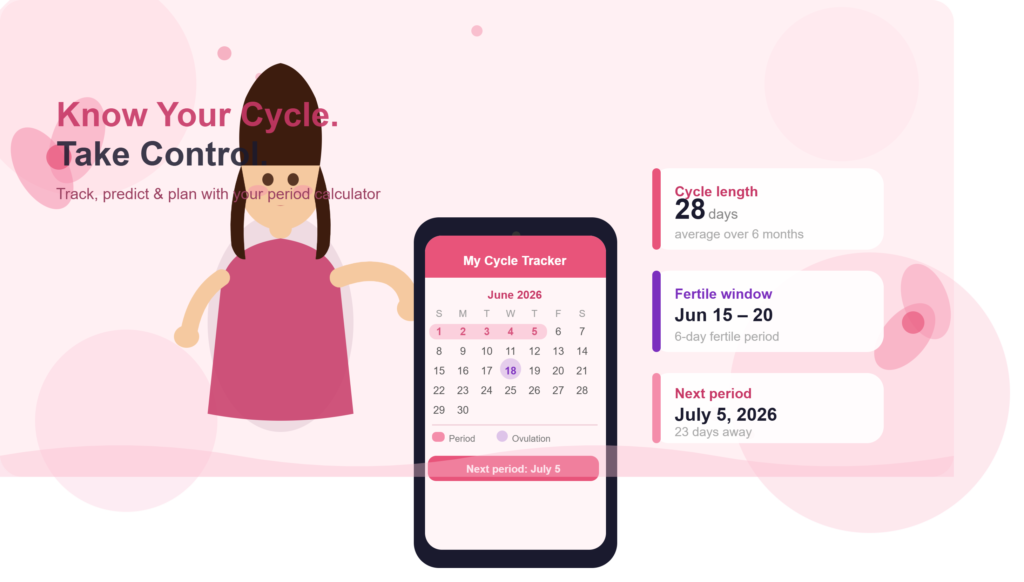
- Enter the first day of your last period : that’s your LMP (last menstrual period).
- Input your average cycle length : typically somewhere between 21 and 35 days.
- Hit calculate : the tool maps out your next period date, ovulation window, and fertile
days.
Most accurate calculators also let you log symptoms, flow intensity, and mood
changes over time. The more data you track, the more personalized and reliable the
predictions become.
7 Powerful Ways a Period Calculator Can Help You
- Never Be Surprised Again
This one’s obvious but it’s underrated. Knowing when your period is coming means you can
carry supplies, plan social events, and skip the frantic Target runs at 10 PM. A reliable
calculator for periods gives you at least a week’s heads-up so you can prepare. - Understand Your Unique Cycle
Not every cycle is 28 days. That’s actually a myth. An accurate calculator tracks your
real-world data and adjusts its predictions accordingly. Over time, it learns whether you run
long, short, or irregular. - Use It as an Ovulation Calculator
If you’re trying to get pregnant, the ovulation window is everything. An ovulation period
calculator pinpoints your most fertile days usually about 14 days before your next expected
period. That’s the sweet spot for conception.
Conversely, if you’re not trying to get pregnant, knowing your ovulation date helps you
understand natural fertility patterns though it should never replace proper birth control. - Support Family Planning
Whether you’re trying to conceive or space out pregnancies, cycle awareness is a
cornerstone of family planning. The last menstrual period calculator is also one of the first
tools OBGYNs use to estimate a due date during pregnancy. In fact, most due date
calculations are based on adding 280 days (40 weeks) to the first day of your LMP. - Spot Irregularities Early
Consistently irregular periods can be a sign of conditions like PCOS (polycystic ovary
syndrome), thyroid disorders, or hormonal imbalances. When you track your cycle with a
period calculator over several months, irregularities become obvious and easier to discuss
with your doctor.
Roughly 1 in 10 women in the US have PCOS, according to the U.S. Department of Health &
Human Services. Early detection through consistent tracking can make a real difference in
managing symptoms. - Manage PMS Like a Pro
Premenstrual syndrome hits about 1–2 weeks before your period. When you know exactly
when that window falls, you can prepare stocking up on comfort foods, adjusting your
workout schedule, or planning lighter workdays. Tracking with a calculator for periods puts
you back in control.
- Communicate Better With Your Doctor
Bringing real data to your gynecologist appointment? That’s a game-changer. Instead of
saying “I think my period is irregular,” you can show months of logged data cycle lengths,
flow intensity, symptom patterns. Your doctor will thank you for it.

Last Menstrual Period Tracker: Why LMP Matters So Much
The last menstrual period calculator isn’t just for pregnancy. It’s a foundational tool in women’s healthcare.
Here’s why LMP is such a big deal:
⦁ Pregnancy dating: Doctors calculate gestational age and due dates from the first day of your LMP.
⦁ Fertility tracking: LMP helps estimate when ovulation occurred.
⦁ Hormonal health assessments: Irregular time gaps since LMP can signal hormonal shifts.
Whenever you visit a new doctor or urgent care clinic, they’ll almost always ask: “When was your last menstrual period?” Knowing that date and having it tracked saves time and improves the quality of your care.
Ovulation Calculator: The Fertility Connection
The ovulation tracker function is one of the most searched features among
women in their reproductive years. Here’s what you need to know:
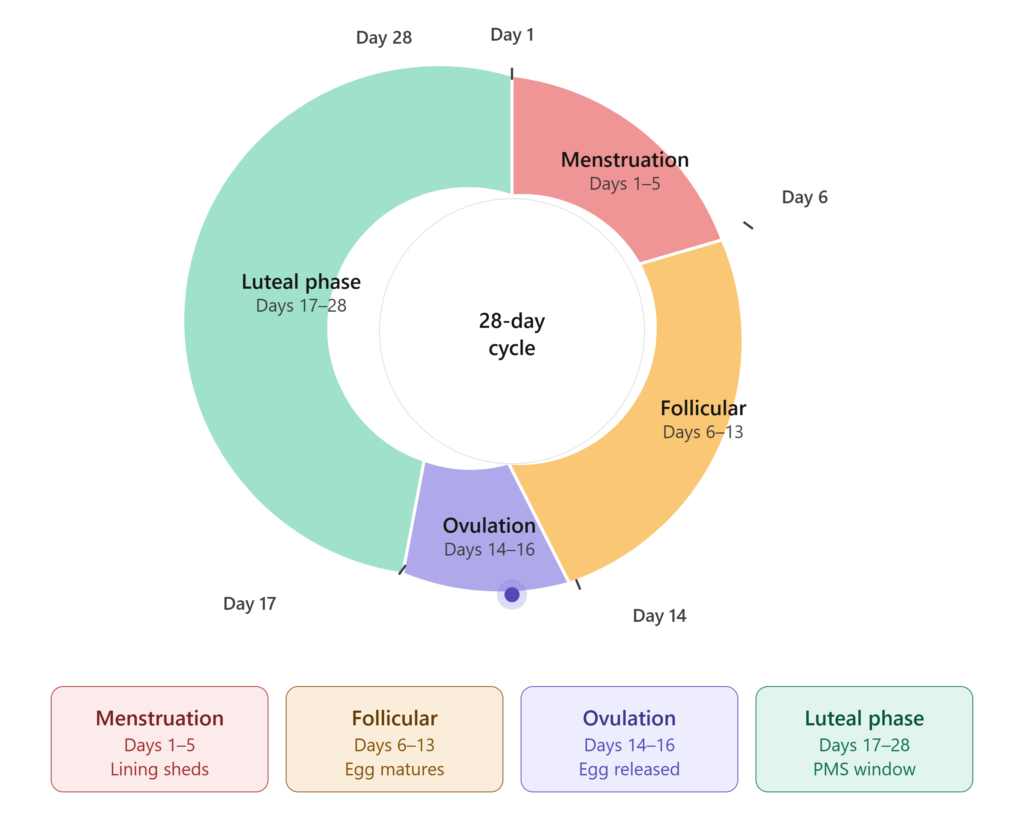
● Ovulation typically happens 12–16 days before your next period.
● Your fertile window is roughly 5–6 days long (a few days before ovulation +
ovulation day itself).
● Sperm can survive inside the body for up to 5 days, so timing matters but there’s
a helpful window.
If you have a 30-day cycle, you’d likely ovulate around Day 16. An accurate tracker does this math automatically and flags those days for you. Some apps even let you log basal body temperature (BBT) or cervical mucus to make predictions even more precise.
How to Choose an Accurate Calculator
Not all period trackers are created equal. Here’s what to look for:
- Algorithm quality: Check if the tool learns from your historical data or just applies a one-size-fits-all formula.
- Track your symptoms: Look for apps that let you log mood, pain levels, flow intensity, and daily energy.
- Built-in ovulation prediction: Ensure there is a reliable ovulation tracker that highlights your fertile day windows.
- Review the privacy policies: This is especially important post-2022. Make sure your personal health data is fully encrypted and not sold to third parties.
- OBGYN-approved features: Some platforms partner directly with healthcare providers to ensure clinical and medical accuracy.
Popular options used by millions of American women include apps like Flo, Clue, and Glow, but always verify the privacy settings before you start logging personal health data.
Whatever you pick, the habit matters more than the app. The best period calculator on the internet is useless if you forget to log your start dates, and the simplest notebook changes your health if you use it every month.
The good news is that you don’t need to pay for anything to get started. This page’s free period calculator handles the core predictions instantly, and a plain notebook or the notes app on your phone is more than enough to track the dates. Fancy features are nice, but consistent, accurate input beats any expensive subscription.
Common Myths About Period Calculators
Myth #1: All cycles are 28 days. False. The 28-day average is just that — an average. Healthy cycles range from 21 to 35 days.
Myth #2: A period calculator can replace birth control. Absolutely not. These tools track fertility windows but are not medically approved as contraception.
Myth #3: Irregular periods mean something is seriously wrong. Not necessarily. Stress, travel, diet changes, and even intense exercise can cause temporary irregularity. However, chronic irregularity should be discussed with a healthcare provider.
Myth #4: You only need a period calculator if you’re trying to get pregnant. Nope. Cycle awareness benefits every woman at every stage of reproductive life.
How to Use a Period Calculator in 3 Simple Steps
Using a period calculator takes less than a minute, and the more you use it the better it gets. Open the tool on this page, enter the first day of your most recent period, and type in your average cycle length. The calculator does the rest, mapping out your next period, your ovulation window, and your estimated PMS days.
Step two is consistency. Log every cycle start, even the early or late ones, so the tool can build a reliable pattern for your body. Step three is patience. Most people see genuinely useful predictions after about three full cycles of data, so don’t judge the tool on its first estimate alone.
If you travel across time zones or simply want a quick second opinion, our global period calculator uses the same logic with extra flexibility for unusual cycle lengths.
What Your Cycle Length Says About Your Health
Your cycle length is one of the clearest windows into your hormonal health, and a period calculator turns that raw number into something you can actually use. A typical cycle runs 21 to 35 days, with most people landing somewhere between 26 and 30. Shorter cycles can suggest a shorter luteal phase, while longer gaps between periods are worth discussing with your provider.
Sudden changes matter too. If your cycle shifts by more than seven days from one month to the next, that’s a signal worth noticing. Tracking makes those shifts visible long before you’d catch them from memory alone. For more on what your body is telling you, read our guide to common menstrual symptoms.
Consistent tracking also helps you spot patterns like two periods in one month or unusually heavy flow, both of which are easier to describe to a doctor when you have months of logged data.
Why the First Day of Your Period Matters So Much
Every prediction a period calculator makes starts from a single date: the first day of your last period, also called your LMP. That’s because doctors and researchers use LMP as the anchor for menstrual dating. From that one day, everything else, ovulation, your fertile window, and even a due date if you’re pregnant, can be calculated with surprising consistency.
Knowing your LMP also makes every healthcare visit smoother. When a nurse asks when your last period started, you won’t have to guess. You’ll have the answer on your phone, ready in seconds. That small habit genuinely improves the care you receive, because accurate answers lead to more accurate assessments.
If you’re pregnant or trying to conceive, this same date is the backbone of every due date estimate. For more context on how your cycle changes across your life, including after childbirth, our guide to your first period after giving birth walks through what to expect.
Period Calculator vs. Tracking Apps: Which Should You Use?
People often assume a period calculator and a period tracking app are the same thing, but they work best together. A calculator gives you fast, reliable predictions from a few key inputs. An app adds symptom logging, mood notes, and long-term charts. If you only want quick answers, a calculator is enough. If you want deep insights, pair the calculator with a simple tracking habit.
Both approaches share the same foundation: accurate LMP data. Whatever tool you choose, the predictions are only as good as the dates you enter. That’s why every serious tracker on the market, including the one built into this site, starts with the same basic period calculator logic.
Tips to Make Your Predictions More Accurate
Your predictions improve the moment you treat tracking like a habit rather than a chore. Set a reminder on your phone for the first day of your period. Record the actual start date, not the day you remember it. Enter your data into the period calculator within a day or two so nothing gets lost.
Watch out for common pitfalls that quietly skew results. Logging a new symptom as a period start, forgetting to update your cycle length, or switching between two different tools can all throw off your predictions. Stick with one calculator and one method, and your accuracy will climb every single month.
Your predictions also improve when you understand the bigger picture of reproductive health. The American College of Obstetricians and Gynecologists (ACOG) publishes clear guidance on what a normal menstrual cycle looks like, which is a helpful benchmark when reviewing your own numbers.
When to See a Doctor About Irregular Cycles
A period calculator is a brilliant planning tool, but it’s not a diagnosis. You should talk to a healthcare provider if your cycles are consistently shorter than 21 days or longer than 35, if you skip periods for several months without being pregnant, or if you bleed heavily enough to change your plans for the day.
Pain that stops you from your normal routine is also worth a conversation. Conditions like PCOS, thyroid problems, and fibroids all show up in your cycle long before they cause serious trouble. If you’re dealing with pelvic discomfort, our article on why your uterus hurts covers the most common causes and when to seek care.
Frequently Asked Questions (FAQ)
Q1: How accurate is a period calculator?
It is most accurate when you have consistent cycle data logged over at
least 3–6 months. For women with regular cycles, predictions can be accurate within 1–2
days. For irregular cycles, accuracy improves as the app learns your patterns over time.
Q2: Can a calculator help me get pregnant faster?
Yes — when used as an ovulation period calculator, it identifies your most fertile days.
Timing intercourse during your fertile window significantly increases your chances of
conception. Many OBGYNs recommend tracking your cycle as a first step when trying to
conceive.
Q3: What is a last menstrual calculator used for?
The last menstrual period (LMP) calculator uses the first day of your most recent period to
predict your next cycle, estimate ovulation, and if you’re pregnant calculate your
estimated due date. It’s one of the most widely used tools in women’s healthcare.
Q4: What if my cycle is irregular will a period calculator still work?
Yes, but it may take a few months of consistent logging to become reliable. Many modern
apps are designed to handle cycle variability. If your irregularity is severe (cycles that vary by
10+ days each month), talk to your doctor about underlying causes.
Q5: Is it safe to use a period calculator app for birth control purposes?
No. Period calculator apps are not a medically approved form of contraception. They can
help you understand your fertile window, but they cannot predict ovulation with 100%
accuracy. Always use a doctor-recommended birth control method for pregnancy prevention.
Conclusion: Take Charge of Your Cycle Starting Today
Your body gives you signals every single month. A period calculator helps you actually hear them. From predicting your next period to identifying your fertile window, tracking your PMS window, and catching irregularities early these tools put real health data in your hands.
You don’t need to be trying to get pregnant to benefit from cycle tracking. Every woman deserves to understand her body, and an accurate period calculator is one of the easiest ways to start.
Ready to take control of your cycle? Start logging your last menstrual period today even one month of data is enough to get meaningful predictions. Your future self will thank you.
This article is for informational purposes only and does not constitute medical advice. Always consult a qualified healthcare provider for personalized guidance on your reproductive health.
Pingback: Period That Has Digits 913: Easy Steps to Name It Correctly
Pingback: Cycle Change From 28 to 31 Days: 8 Simple Reasons That Help
Pingback: Substituted Accounting Period: 9 Easy Steps to Change Your Year
Pingback: Can You Swim on Your Period? 9 Easy Ways to Stay Comfortable
Pingback: Implantation Bleeding vs Period: 9 Easy Ways to Tell Them Apart
Pingback: Can You Get Pregnant on Your Period? 9 Easy Ways to Know Your Risk
Pingback: Calculator for Periods: 9 Easy Ways That Help You Track
Pingback: Pregnancy Wheel Period Calculator: 7 Smart Ways That Help
Pingback: Global Period Calculator: 9 Easy Ways That Help You Bill
Pingback: Cramps But No Period: 13 Easy Reasons That Help You Understand
Pingback: Phantom Period: 9 Easy Ways to Help You Understand
Pingback: My Period Is 4 Days Late but I Have Cramps: 13 Easy Reasons That Help You