
Trying to guess when your next period will show up is frustrating. A calculator for periods exists specifically to end that guesswork. One month it’s early, the next it’s late, and you’re left checking your underwear more than your calendar.
That’s exactly why a calculator for periods exists. Once you understand how it works, a calculator for periods becomes a reliable part of your routine. It takes the guesswork out of cycle tracking by using simple math based on your past periods to predict your future ones.
In this guide, I’ll walk you through how these calculators work, how to use one correctly, and what they can (and can’t) tell you about your body. By the end, using a calculator for periods will feel completely straightforward.
What Is a Period Calculator?
A period calculator is a simple tool that estimates your next period based on the length of your past cycles. You enter the start date of your last period and your average cycle length, and it does the math for you.
Most calculators also estimate your fertile window and ovulation date. That fertile window is one of the most valuable outputs of any calculator for periods. That’s useful whether you’re trying to conceive or trying not to.
Think of it like a weather forecast for your body. That comparison is a good way to set expectations for any calculator for periods. It’s not perfect, but it gives you a solid heads-up so you’re not caught off guard.
Why People Search for This Tool
Millions of women in the US use period calculators every month. The popularity of a calculator for periods shows how many people benefit from simple cycle math. Some want to plan vacations or workouts around their cycle. Others are tracking symptoms like cramps or mood swings to talk to their doctor.
According to the American College of Obstetricians and Gynecologists, a typical menstrual cycle runs between 21 and 35 days, with periods themselves lasting two to seven days. That’s a wide range, which is exactly why tracking matters more than guessing.
How Does a Calculator for Periods Work?
The math behind a period calculator is straightforward. Understanding the formula is what separates a helpful calculator for periods from a confusing one. It’s not magic, just basic averages.
The Basic Formula
Here’s the simple version:
- Take the first day of your last period
- Add your average cycle length (most women average 28 days, but anywhere from 21 to 35 is normal)
- That gives you the estimated start date of your next period
For ovulation, the calculator typically subtracts about 14 days from your next expected period date. That’s usually when you’re most fertile.
What It Can’t Predict
A period calculator works off averages, not certainties. Keep that caveat in mind and a calculator for periods will never mislead you. Stress, travel, illness, weight changes, and even poor sleep can shift your cycle by days.
So if the calculator says your period starts on the 15th and it shows up on the 17th, that’s normal. Your body isn’t a Swiss watch, and it’s not supposed to be.
Why Tracking Your Period Matters
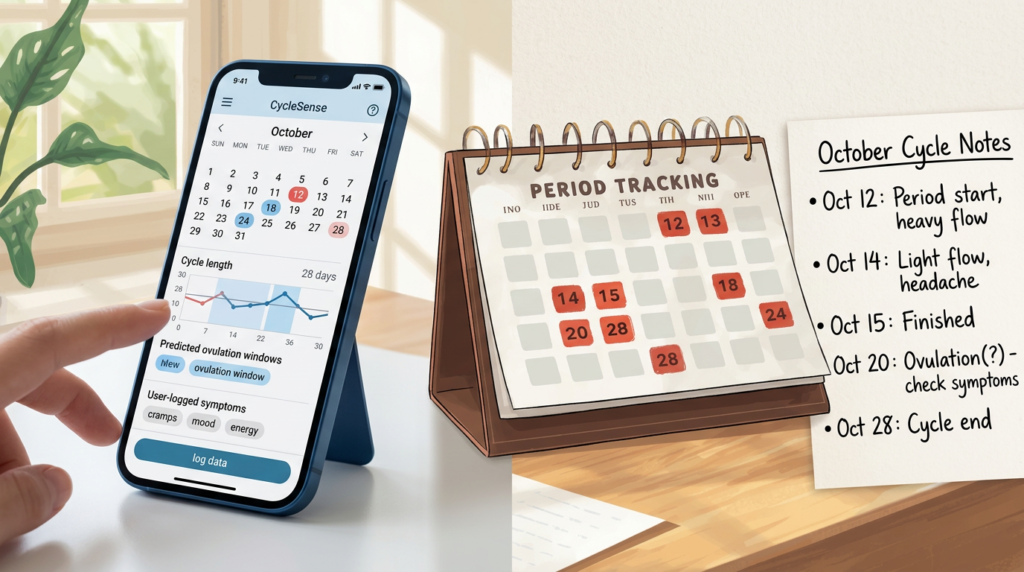
Tracking isn’t just about avoiding surprises. It also makes a calculator for periods far more accurate, because the tool learns from your history. It actually tells you a lot about your overall health.
Here’s what regular tracking can help you spot:
- Irregular cycles that might signal a hormonal issue
- PMS patterns, so you know when symptoms are coming
- Fertility windows, whether you’re trying to conceive or avoid it
- Changes over time, which can be worth mentioning to your doctor
Doctors often ask about your last period and cycle length at checkups. Bringing output from a calculator for periods gives your doctor solid numbers to work with. Having that data ready saves time and gives them better info to work with.
How to Use a Period Calculator Step by Step
Using one of these tools takes less than a minute. That speed is the whole appeal of a calculator for periods. Here’s how to do it right.
- Find the start date of your last period. This is day one, the first day of actual bleeding, not spotting.
- Know your average cycle length. If you’re not sure, count the days from the start of one period to the start of the next, across two or three months.
- Enter both into the calculator. Most tools also ask if your cycles are regular or irregular. Answer honestly, because a calculator for periods depends on accurate inputs.
- Review your results. You’ll get an estimated next period date, fertile window, and sometimes ovulation day.
- Track for a few months. Accuracy improves the more cycles you log, since the calculator learns your personal pattern.
If your cycles are wildly inconsistent, the calculator’s prediction will be a rough range instead of an exact date. That’s still useful information, just take it as an estimate.
Period Calculator vs. Tracking Apps
A basic calculator gives you a quick answer. That quick answer is the main reason people prefer a calculator for periods over a full app. A tracking app gives you a fuller picture over time.
Here’s the real difference:
Period calculators are best for a fast, one-time estimate. If you just need one date, a calculator for periods is the ideal choice. You plug in two numbers and get a date.
Tracking apps store your history, send reminders, and adjust predictions automatically as your data grows. Many also log symptoms like cramps, headaches, or mood changes alongside your cycle.
If you just need to know “will my period mess up my beach trip,” a calculator is plenty. If you want long-term insight into your cycle health, an app is worth downloading.

Common Mistakes People Make
Even a simple tool can give bad results if you feed it bad info. That rule applies to every calculator for periods. Watch out for these:
- Using the wrong start date. Spotting doesn’t count as day one; full flow does.
- Guessing your average cycle length. A wrong number throws off every prediction after it.
- Ignoring irregular cycles. If your periods vary by more than a week each month, mention this to a doctor instead of relying only on the calculator.
- Forgetting to update after missed predictions. If your period comes early or late, log that real date so future predictions improve.
Small errors compound. Garbage in, garbage out, just like any other calculator.
When to See a Doctor Instead of Relying on a Calculator
A calculator is a helpful tool, but it’s not a substitute for medical advice. When in doubt, take the output of a calculator for periods to your doctor. You should talk to a doctor if:
- Your periods stop for three months or more without pregnancy
- Your cycle length changes drastically and stays that way
- You’re bleeding through a pad or tampon every hour for several hours straight
- Your periods last longer than seven days regularly
These could point to conditions like PCOS, thyroid issues, or fibroids. A calculator can’t diagnose anything, it just tracks patterns.
What a Calculator for Periods Can Tell You
Beyond the obvious next period date, a calculator for periods reveals several useful things about your cycle that most people never think to look for. Once you run the numbers a few times, you start spotting patterns that make planning much easier.
- Your fertile window. Knowing roughly when you’re most fertile is useful whether you’re trying to conceive or timing around travel and events.
- Estimated ovulation day. The tool subtracts about 14 days from your expected period date to estimate when the egg is released.
- Cycle regularity. When you compare predictions to reality over several months, you learn how regular, or irregular, your cycle really is.
- Late period alerts. When the expected date passes with no period, the calculator makes the delay obvious, which is often the first clue people notice.
A calculator for periods is essentially a simple spreadsheet of your cycle history, organized into a prediction. The more months you feed it, the more personalized and useful it becomes.
How to Calculate Your Average Cycle Length
If you’re not sure what your average cycle length is, you can work it out in a few minutes with a calendar. The cycle length is the number of days from the first day of one period to the first day of the next.
Here’s the method: mark the first day of bleeding for three consecutive periods. Count the days between period one and period two, then between period two and period three. Add those two numbers together and divide by two, and you have a simple average to enter into any calculator for periods.
For example, if your cycles were 29, 31, and 28 days, your average is roughly 29 days. A calculator for periods then uses that number to predict your next start date with reasonable confidence, usually within a day or two for a regular cycle.
More Tools to Understand Your Cycle
If you’re getting comfortable with the idea of tracking, the global period calculator on this site helps when you’re traveling or juggling dates across time zones. You can also compare your tracking notes with guides on signs your period is coming late and menstrual symptoms, which fill in the details a number alone can’t give you.
For trustworthy medical background, the American College of Obstetricians and Gynecologists publishes clear, evidence-based patient education about the menstrual cycle. Unlike a calculator for periods, a doctor can interpret patterns in context and rule out underlying conditions.
How Accurate Is a Calculator for Periods Really?
Accuracy is the most common question, and the honest answer is that it depends entirely on how regular your cycle is. For someone with a predictable 28-day cycle, a calculator for periods is usually accurate to within a day or two. For someone whose cycles swing between 24 and 36 days, the prediction is a wider window rather than a single date.
There’s also a subtle point worth understanding: the tool is only as good as the data you give it. If you enter the wrong start date, or you average cycles that include a month where you were ill or extremely stressed, the prediction shifts. That’s not a bug in a calculator for periods, it’s simply how averages work.
To get the most reliable result, use at least three months of cycle history, enter the first day of full flow, and update the log every single cycle. Small habits like these take a calculator for periods from “rough guess” to “genuinely useful planning tool.”
Getting the Most From Your Cycle Data
Once you’ve been tracking for a few months, you’ll have a small dataset that’s worth looking at more closely. Open your history and notice whether your cycle tends to shorten in winter, lengthen during busy travel seasons, or shift around major stress. These personal patterns are exactly what a doctor finds useful when you bring your tracker to an appointment.
You can also pair your calculator for periods with simple notes about symptoms. Jot down whether you had cramps, headaches, bloating, or mood changes each month. After three or four cycles, you’ll see which symptoms reliably arrive a few days before your period, which helps you prepare instead of react.
The end goal isn’t a perfect prediction, it’s understanding your own body well enough that surprises stop being scary. A calculator for periods is one of the easiest first steps toward that understanding.
It’s also worth remembering that every body is different. A cycle that looks short to one person may be completely normal for someone else, which is why comparing yourself to averages, rather than to friends or strangers online, is the most helpful mindset. Your own history is the only baseline that matters, and the more of it you record, the clearer your personal rhythm becomes.
Frequently Asked Questions
Is a period calculator the same thing as a periodic table?
No, and this mix-up happens more than you’d think, especially with students searching online. A period calculator tracks your menstrual cycle. The periodic table of elements is a chemistry chart listing elements like hydrogen and oxygen. The words “period” and “periodic” just happen to overlap in search results.
How accurate is a calculator for periods?
It’s accurate for women with regular cycles, often within a day or two. For irregular cycles, it gives a wider estimated range rather than an exact date.
Can a period calculator tell me if I’m pregnant?
Not directly. It can tell you that your period is late based on your average cycle, which is often the first sign people notice. A missed period doesn’t confirm pregnancy, but it’s a signal to take a test.
What’s a normal cycle length?
Most cycles run between 21 and 35 days, with 28 days being the average. Anything consistently outside that range is worth mentioning to a healthcare provider.
Do I need an app, or is a simple calculator enough?
If you just want a quick estimate, a calculator works fine. If you want symptom tracking, reminders, and long-term pattern insight, an app is the better choice.
How do I enter irregular cycles into a calculator for periods?
Most tools let you pick “irregular” and then show a predicted range instead of a single date. You can also enter your average cycle length based on the last three months, knowing the range will be wider.
Can a calculator for periods help me plan a vacation?
Yes, that’s one of its most practical uses. Enter your cycle data a month or two ahead and you’ll see roughly when your next period is due, so you can plan swim days, hiking trips, and events around it.
Why does my predicted period keep changing?
Because the calculator is learning from your data. Every cycle you log updates the average, so predictions naturally shift a little until your pattern stabilizes. That’s normal, and it means the tool is working correctly.
Should I share my calculator results with my doctor?
It can be genuinely useful. A printed or screenshotted history of your last three to six cycle dates gives your doctor concrete data about length and regularity, which supports better conversations about anything from period pain to fertility planning.
Final Thoughts
A calculator for periods won’t replace your doctor, but it will save you from a lot of unnecessary stress and last-minute trips to the store. Used well, a calculator for periods makes cycle planning genuinely simple.
One last tip before you go: set a small reminder to log the first day of your period each month. That single habit, repeated consistently, gives you the three-month history that makes a calculator for periods accurate. Combine it with a quick note about how you felt, and you’ll soon have a personal record that’s far more valuable than any generic prediction.
Start tracking your next cycle today, even just on a basic calendar. Then try a calculator for periods next month and watch the predictions improve., and you’ll already be ahead of where most people start.