How to write the name of the period that has digits 913
Staring at a massive string of digits is enough to make anyone’s eyes glaze over. If you or your kid are looking at a math worksheet asking you to “write the name of the period that has digits 913,” you are in the right place. Figuring out the period that has digits 913 is a classic place value question you might feel completely stuck. You aren’t alone. When numbers stretch past six or nine digits, keeping track of what each group actually means gets tricky.
Finding the right answer depends entirely on where those specific numbers sit in the lineup. In every example below, the same rule identifies the period that has digits 913. Here is exactly how place value periods work, how to identify them, and a few insider tricks to avoid the most common grading traps.
The Basics: What on Earth is a “Period” in Math?
In everyday writing, a period is a dot at the end of a sentence. In the math world, a period is a neighborhood of three digits separated by commas.
We read numbers from left to right, but we build place value periods from right to left starting at the decimal point. Each group of three houses has a specific name:
The Ones Period: Contains ones, tens, and hundreds.
The Thousands Period: Contains thousands, ten-thousands, and hundred-thousands.
The Millions Period: Contains millions, ten-millions, and hundred-millions.
The Billions Period: Contains billions, ten-billions, and hundred-billions.
This exact pattern repeats forever as numbers get larger, moving into Trillions, Quadrillions, and beyond. If you’d like an independent walkthrough of the same idea, Math is Fun’s place value guide is a handy companion for this article.
Identifying the 913 Period
Because the sequence 913 can land anywhere in a giant number, the name of the period that has digits 913 depends on its exact location. You have to look at the surrounding commas to know what to call it.
Here is how that plays out in a few real-world examples.
Scenario A: The 913 is in the Thousands Period
Look at the number 45,913,200.
Here, 913 sits right between the millions and the ones. Because of its location, the period that has digits 913 is the thousands period.
You read this out loud as: “Forty-five million, nine hundred thirteen thousand, two hundred.” See how the name of the period that has digits 913 gets tacked onto the end of “nine hundred thirteen.”
Scenario B: The 913 is in the Millions Period
Now look at the number 913,400,000.
The digits have shifted all the way to the left side of the commas, and so has the name of the period that has digits 913.
You read this as: “Nine hundred thirteen million, four hundred thousand.”
Scenario C: The 913 is in the Ones Period
The simplest case is a number like 3,913 or even just 913 on its own. Here the digits 913 sit in the last three positions before the decimal point, and the period that has digits 913 is the ones period, which means they belong to the ones period. You read this as “three thousand, nine hundred thirteen.” Notice that no neighborhood name gets tacked onto the end, because the ones period’s name is always silent.
This is the trap most people fall into on a quiz. The worksheet asks you to name the period that has digits 913, you look at a small number like 913, and you second-guess yourself wondering if there even is a period name to give. There is, and it’s the ones period. The ones period is still a period, even though we don’t say its name out loud.
Scenario D: The 913 is in the Billions Period
Now push the digits all the way left with a number like 913,204,008,125. This time the period that has digits 913 is all the way over in the billions Reading right to left, the first group is the ones period (125), the next is the thousands (008), the next is the millions (204), and the leftmost group is the billions (913). So the period that has digits 913 here is the billions period, and you’d read it as “nine hundred thirteen billion, two hundred four million, eight thousand, one hundred twenty-five.”
Run the same reasoning on any longer number and the pattern never changes. The digits 913 always get read as “nine hundred thirteen,” and the only thing that changes is the neighborhood name at the end. If 913 is the second group from the right, it’s thousands. Third from the right, millions. Fourth from the right, billions. Memorize that right-to-left counting rule and you can name the period that has digits 913 in any number, no matter how long.
A Step-by-Step Method for Any Number
If you want a repeatable method instead of memorizing examples, use this four-step routine. Step one, write the full number with commas in the standard places. Step two, find the group of three digits that starts with 913, ignoring any commas inside your head. Step three, count groups from right to left, starting at the ones period as group one. Step four, map the group number to a name: one is ones, two is thousands, three is millions, four is billions, five is trillions, and so on. That final name is the answer to “what is the period that has digits 913.”
This method is exactly what a teacher is grading for, so it’s worth practicing until the counting feels automatic. Try it right now with 5,913,000. The 913 is the second group from the right, so the answer is the thousands period. If you got that, you’ve officially mastered the core idea, and you can apply it to every other scenario in this guide.
Why Worksheets Ask This Question in the First Place
Questions like “name the period that has digits 913” aren’t random busywork. They’re testing a very specific skill: whether you can decompose a large number into its three-digit neighborhoods and label each one correctly. That skill matters far beyond fourth grade math, because adults use it every time they read a budget, scan a company’s quarterly report, or glance at a national statistic in the news.
Teachers also design these problems to catch a common misunderstanding. Many students can read a seven-digit number out loud but can’t explain which group a particular block of digits lives in. By asking about a specific block like 913, the worksheet forces you to prove you understand the structure, not just the sound. That’s why the wording is so specific about “the period that has digits 913” instead of just asking for a general definition.
Once you see the underlying goal, the question stops feeling like a trick. The number 913 is just a placeholder the worksheet picked; the real lesson is the right-to-left counting system that works for any block, whether it’s 913, 042, or 777. So when your kid hands you a worksheet and asks for help, walk through the counting rule out loud instead of just giving the answer. Explaining it is the fastest way to make it stick, for both of you.
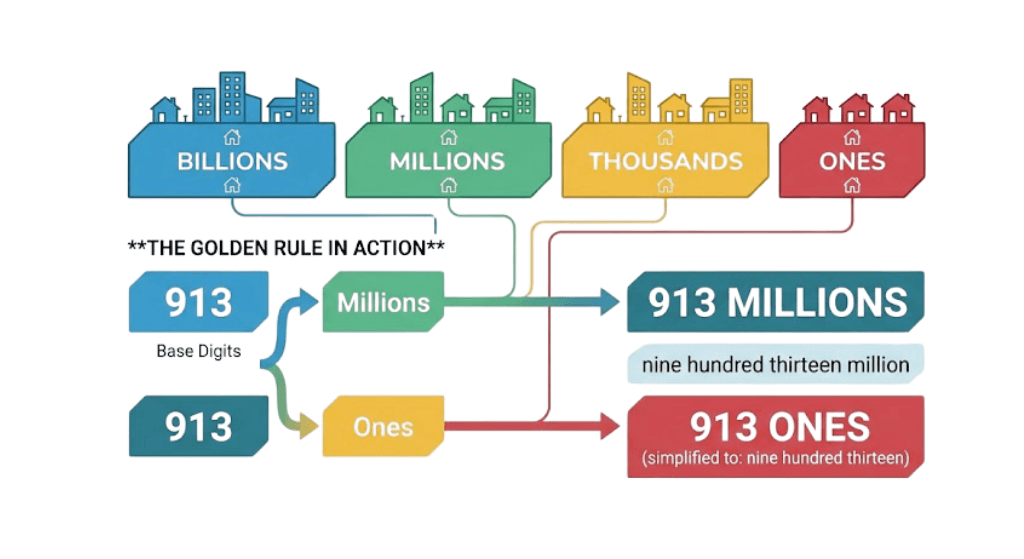
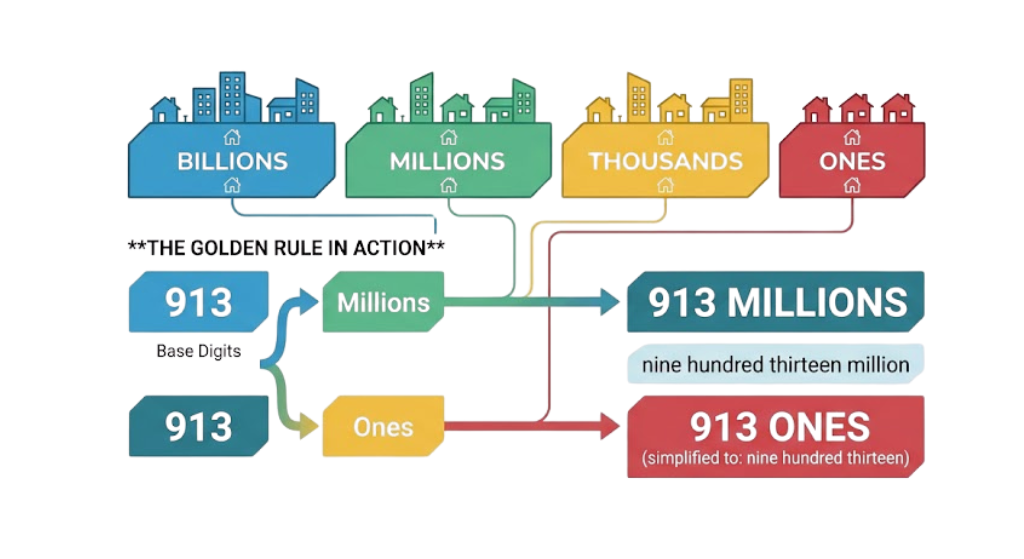
The Golden Rule: A period is just the name of the neighborhood where those three digits live. The digits 913 will always be read as “nine hundred thirteen.” You just tack the neighborhood name onto the end of the phrase.
Common Mistakes to Watch Out For
Place value trips up plenty of students and adults alike. Getting the period that has digits 913 wrong is one of the most common place value errors. If you are helping a fourth or fifth grader with homework, watch out for these two exact pitfalls.
1. Sneaking in the Word “And”
When reading 913 out loud, most of us naturally say “nine hundred and thirteen.” That habit matters even when you are naming the period that has digits 913.
Try to break this habit immediately. In formal math, the word “and” is strictly reserved for decimal points. Saying “and” in the middle of a whole number tells a math teacher you are talking about fractions or cents.
Wrong: Nine hundred and thirteen thousand.
Right: Nine hundred thirteen thousand.
2. Miscounting from the Wrong Side
When figuring out which period 913 belongs to, always count your groups of three starting from the right side (where the invisible decimal point lives) and move left. If you count from left to right, a single extra digit at the front of the number will throw off your entire answer.
3. Forgetting That the Ones Period Counts
This is a sneaky one. Students often start counting periods at the thousands, skipping the ones period entirely, because the ones period “doesn’t have a name.” But when you’re asked for the period that has digits 913, the ones period absolutely counts as group number one. If 913 is in the second group, that’s thousands, not millions. Skipping the ones period shifts everything by one and produces a wrong answer on every single problem.
4. Reading 913 as Two Separate Chunks
Some students try to read 913 as “nine, one, three” or “nine thirteen,” especially under time pressure. Always read it as the single number nine hundred thirteen. The period that has digits 913 is identified by where the whole three-digit block sits, not by reading the digits one at a time. Keeping the block together is what lets you match it to the correct neighborhood name.
Trade-offs: Commas vs. Spaces
Depending on where you live or what industry you work in, large numbers format differently. Knowing this prevents a lot of confusion if you ever look at an international financial spreadsheet.
Format Type
Example
Pros
Cons
US Standard (Commas)
913,000,000
Super easy to count periods at a glance.
Can be confused with decimals in parts of Europe.
International (Spaces)
913 000 000
Clean and universally understood.
Easy to misread if the font spacing is tight.
In the United States, we stick to commas to separate our periods. Commas make it obvious which period has the digits 913 in any big number. It keeps the 913 cleanly boxed in so your brain can process the math instantly.
A Quick Reference Chart for Every Period Name
Memorizing the list below removes any guesswork, because the answer to “what is the period that has digits 913” is always one of these names, and only one. The table reads from right to left, exactly the way you should count. The ones period is always group number one, even though we don’t say its name aloud. The thousands period is group two, the millions period is group three, the billions period is group four, and the trillions period is group five. After that the names keep coming every three digits: quadrillions in group six, quintillions in group seven, sextillions in group eight, septillions in group nine, octillions in group ten, and nonillions in group eleven.
It’s worth noticing how the pattern builds. Each new name adds three zeroes and three more digit positions on the left. The digit block itself never changes the way it’s read, which is the whole point of the system. If you understand that one idea, you can name the period that has digits 913 in a number with two digits or in a number with twenty digits, and you’ll get the same kind of answer every single time. The block is always read as nine hundred thirteen, and the period name is always determined by its distance from the decimal point.
Here is a useful mental shortcut that teachers love and students forget. Picture the number 913,000,000. Now delete the three zeros and think of it as 913 in the millions. Then picture 913,000,000,000 and think of it as 913 in the billions. Notice how each new group of three zeros moves the 913 one name to the left. Count the groups of zeros in the whole number, add one for the ones period, and you have the group number, which maps directly to the period name. This trick is fast enough to use during a timed quiz, and it’s exactly the kind of reasoning the worksheet wants you to demonstrate.
One last tip for parents helping at home. When your kid is stuck on the period that has digits 913, don’t just hand over the answer. Cover the number, ask them to insert the commas themselves, and then ask which group the 913 landed in and what that group is called. Having them say the words out loud, “thousands period” or “millions period,” locks the concept in far better than silent reading ever will. A few repetitions with different numbers, 913 in the thousands, then the millions, then the ones, and the skill becomes permanent.
FAQs About Place Value Periods
How do you write 913 in expanded form?
If 913 is just a standalone number in the ones period, the expanded form looks like this:
$$900 + 10 + 3$$
If it sits in the thousands period (as in 913,000), the expanded form stretches out:
$$900,000 + 10,000 + 3,000$$
Why do we group numbers into periods of three?
Human brains are terrible at processing long, unbroken strings of characters. Imagine trying to read 913000000000 quickly. By breaking numbers into three-digit chunks, your eyes instantly categorize the size of the value without having to count zeroes one by one.
What comes after the billions period?
The pattern grows exponentially: Millions, Billions, Trillions, Quadrillions, Quintillions, Sextillions, and Septillions. Each one introduces a brand new three-digit period to the left.
Is there always a period that has the digits 913?
Not in every number. The digits 913 only exist as a group if the number actually contains that exact block of three digits somewhere. For example, the number 8,204,510 contains the digit 9, the digit 1, and the digit 3 scattered in different places, but it does not contain the consecutive block 913. When a worksheet says “the period that has digits 913,” it’s telling you that the consecutive three-digit block 913 is present, and your job is only to name its place.
Do zeros affect the period that has digits 913?
Not in terms of naming. In a number like 913,045,000, the 913 still sits in the millions period even though the groups after it contain zeros. Zeros change how you say the number out loud, but they never change which group the 913 belongs to. Count the groups, ignore the zeros for naming purposes, and you’ll get the same answer every time.
Can the period that has digits 913 ever be two groups at once?
No. Because periods are defined by position, the block 913 lives in exactly one group in any given number. It can’t span two groups, since commas always separate groups of exactly three digits. The question “which period has the digits 913” always has a single, unique answer once you’ve written the number with standard commas.
What if the worksheet uses no commas at all?
Then you add them yourself before doing anything else. For instance, the string 45913200 becomes 45,913,200 once you insert the commas from the right. Only then can you confidently say that the period that has digits 913 is the thousands period. Always insert commas first; every shortcut in this article assumes you’ve done that step.
Practice Problems to Test Yourself
Working through examples is the fastest way to make the naming rule stick, so here are four quick drills. Grab a scrap of paper and cover the answers below each one.
In 61,913,000, what is the period that has digits 913? (Answer: thousands period, because it’s the second group from the right.)
In 913,000,000,000, what is the period that has digits 913? (Answer: billions period, the fourth group from the right.)
In 4,913, what is the period that has digits 913? (Answer: ones period, the first group from the right.)
In 500,913,200,000, what is the period that has digits 913? (Answer: millions period, the third group from the right.)
If you missed one, go back and count the groups from the right one more time, starting at the ones period. With a little repetition, naming the period that has digits 913 becomes as automatic as reading a three-digit number, and that’s exactly the skill level the worksheet is testing for.
The Bottom Line on Large Numbers
Getting the right answer on your assignment just comes down to looking at the commas. Spot the block, count the groups, and the period that has digits 913 names itself. Once you locate where those three digits sit, read them as a normal three-digit number and finish with the name of their place value neighborhood. Master that simple visual trick, and you can decipher any giant number handed to you.
To recap the whole lesson in one sentence: find the block 913, count its group position from the right starting at the ones, and attach the matching name. Whether it’s the ones, thousands, millions, or billions period, the rule never bends. And if number work like this ever sends you hunting for a quick calculation, our site has tools that take the guesswork out of working with numbers, including a global period calculator and a period calculator you can rely on for fast results.
Need help with another specific math problem? Leave a comment below with the number that’s tripping you up, and let’s break it down together!
Contains information related to marketing campaigns of the user. These are shared with Google AdWords / Google Ads when the Google Ads and Google Analytics accounts are linked together.
90 days
__utma
ID used to identify users and sessions
2 years after last activity
__utmt
Used to monitor number of Google Analytics server requests
10 minutes
__utmb
Used to distinguish new sessions and visits. This cookie is set when the GA.js javascript library is loaded and there is no existing __utmb cookie. The cookie is updated every time data is sent to the Google Analytics server.
30 minutes after last activity
__utmc
Used only with old Urchin versions of Google Analytics and not with GA.js. Was used to distinguish between new sessions and visits at the end of a session.
End of session (browser)
__utmz
Contains information about the traffic source or campaign that directed user to the website. The cookie is set when the GA.js javascript is loaded and updated when data is sent to the Google Anaytics server
6 months after last activity
__utmv
Contains custom information set by the web developer via the _setCustomVar method in Google Analytics. This cookie is updated every time new data is sent to the Google Analytics server.
2 years after last activity
__utmx
Used to determine whether a user is included in an A / B or Multivariate test.
18 months
_ga
ID used to identify users
2 years
_gali
Used by Google Analytics to determine which links on a page are being clicked
30 seconds
_ga_
ID used to identify users
2 years
_gid
ID used to identify users for 24 hours after last activity
24 hours
_gat
Used to monitor number of Google Analytics server requests when using Google Tag Manager