
If you are newly postpartum and waiting for your cycle to come back, you are probably wondering how your first period after giving birth will look, how long it lasts, and when exactly it should show up. The short answer: your first period after giving birth usually lasts five to seven days, arrives anywhere from weeks to months after delivery depending on breastfeeding, and often looks different from the periods you had before pregnancy.
This guide covers the whole timeline so the first period after giving birth stops feeling like a guessing game. You will learn how it differs from the healing bleed called lochia, why some parents get it at six weeks while others wait a year, and which signs are worth a quick call to your doctor.
How Long Does Your First Period Last After Giving Birth?
Your first period after giving birth typically lasts five to seven days, though anywhere from three to ten days is still considered normal. It usually shows up heavier and with more clotting than your pre-pregnancy periods, and it won’t start until the postpartum bleeding called lochia has fully stopped.
Key takeaway: Lochia is not your period. It’s a separate healing process that can run for up to six weeks. Your actual period comes later, once your uterus has finished shedding that lining.
I remember counting days on my phone calendar after my second baby, half expecting my body to just pick up where it left off before pregnancy. It didn’t. The bleeding was heavier, the cramps hit different, and it took me a solid two cycles before things felt familiar again. That’s actually pretty typical, and nobody really warns you about it beforehand.
Lochia vs. Your Actual Period
Right after delivery, whether vaginal or C-section, your body sheds the uterine lining that supported your pregnancy. This is lochia, a healing discharge described by Cleveland Clinic, and it moves through three stages: heavy bright red bleeding for the first few days, then a pinkish-brown flow, then a lighter yellowish-white discharge that can linger for a few weeks.
Once lochia has fully cleared, your body is starting fresh. Your first true period is a completely separate event tied to your hormones resetting and ovulation returning, not a continuation of that healing bleed.
It also matters that the first period after giving birth is not the same as lochia timing for everybody. Some parents see a light period as early as four weeks, while others who breastfeed on demand may not see anything for over a year. Both timelines are within the wide range of normal, so the most helpful move is to watch your own pattern rather than compare to one story.
A Simple Week by Week View of the First Period After Giving Birth
Thinking in weeks makes the wait far less stressful than staring at a month with no period. During the first two weeks after delivery you are usually still passing lochia, that healing discharge, which is not counted as your period at all. By weeks three to six, the lochia phases out, and for many parents this is the window where the first period after giving birth quietly shows up.
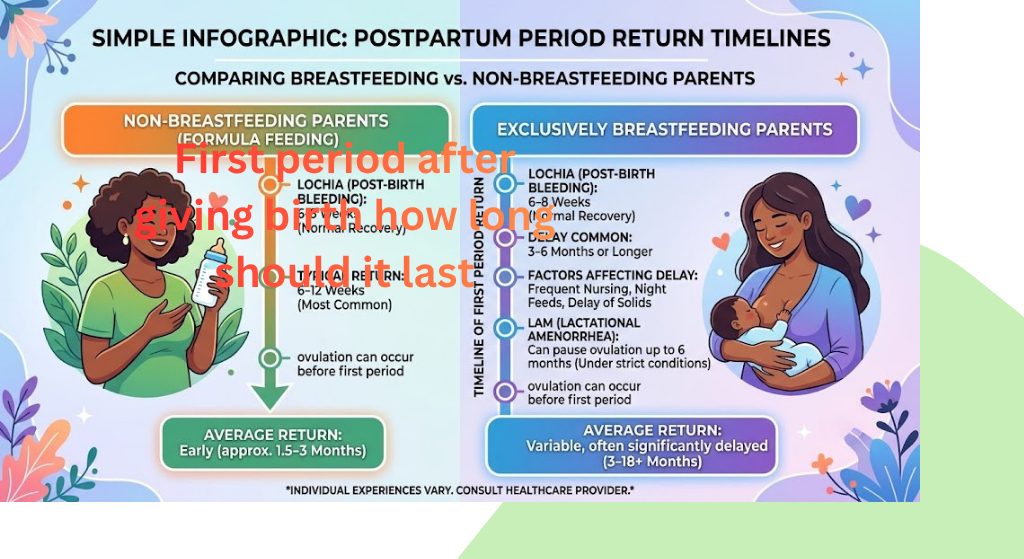
If you are not breastfeeding, the first period after giving birth most often returns between six and eight weeks, right around that common postpartum checkup. For combination feeders it is a little later, and for exclusive breastfeeding parents it can be delayed for several months or more. The unifying rule is simple: your period returns after your fertility hormones come back, and that timing is highly individual.
Use your sleep log to remember that ovulation usually comes before the first visible bleed. Many parents track their first period after giving birth with a blank calendar and are surprised to see cramping or mood signs a week or so before the flow, which is simply the return of a normal cycle in progress.
What a Healthy First Period After Giving Birth Feels Like
A reassuring baseline: a normal first period after giving birth lasts about as long as a typical period and may be heavier. Cramps may be sharper in the first cycle because your uterus layers, and this is expected. The main thing to watch is not how it compares to your old periods, but whether the bleeding soaks pads at dangerous speed or comes with fever or bad odor.
For many people, the first period after giving birth is the heaviest they have ever had, then settles into something lighter by the second or third cycle. That gradual settling, not a sudden return to pre-pregnancy normal, is exactly what doctors expect to see, and it is a sign your hormones are rebuilding their rhythm step by step.
When Does Your First Period Actually Show Up?
This is where things vary a lot, and breastfeeding is the biggest factor.
- If you’re not breastfeeding, your period often returns six to eight weeks after delivery, sometimes sooner.
- If you’re combination feeding (breast and formula), expect somewhere in the five-to-twelve-week range.
- If you’re exclusively breastfeeding, prolactin can suppress ovulation for several months, sometimes up to a year or longer for some parents.
- A clinical review published in Obstetrics & Gynecology found that most periods return somewhere between 45 and 94 days after childbirth across the general population.
One thing worth knowing: you can ovulate before that first period ever shows up. That means it’s possible to get pregnant again before you’ve had a single postpartum period, which surprises a lot of new parents.
What Makes That First Period Different
Your body just spent nine months building and then releasing a completely new uterine environment. It makes sense that the first few cycles feel off, and the menstrual symptoms you notice can be more pronounced than before. Common changes include:
- Heavier flow than you’re used to, sometimes with larger clots
- Stronger or different cramping, since your uterus is still finishing its shrinking process
- Irregular timing for the first few cycles as hormones recalibrate
- Lighter periods for some people, particularly those who are still partially breastfeeding
A friend of mine swore her post-baby periods were lighter and shorter than before. Another described hers as the heaviest of her life. Both are within the range of normal. There isn’t one script everyone follows here.
Product Changes Worth Knowing About
If you used a menstrual cup before pregnancy, you may need a different size. Most cup brands sell a “post-childbirth” size because your cervix and vaginal canal can change shape slightly after delivery. Pads tend to be the easiest option for the first cycle or two while you gauge your flow, and tampons are fine again once your doctor clears you for full activity, usually around the six-week checkup.
When to Call Your Doctor
Most postpartum bleeding, whether it’s lochia or your first real period, resolves on its own. But a few signs mean it’s time to check in with your provider rather than wait it out:
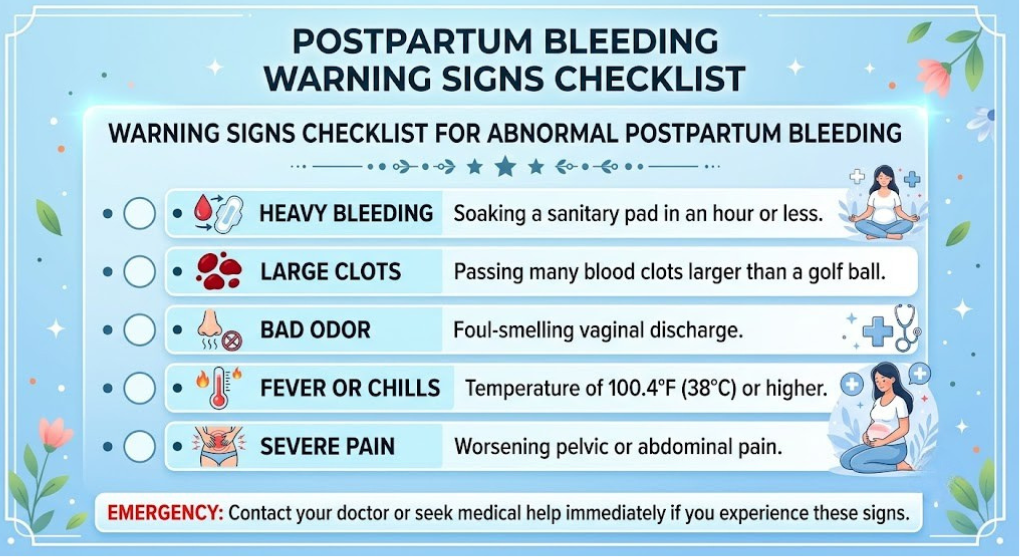
- Soaking through a pad in an hour or less, repeatedly
- Passing clots larger than a golf ball
- Bleeding that lasts more than 10 days with no signs of slowing
- Fever, foul-smelling discharge, or intense abdominal pain alongside the bleeding
- No period at all by six months postpartum if you’re not breastfeeding
Postpartum hemorrhage is rare but serious, and providers would much rather get a call that turns out to be nothing than have a parent tough it out alone.
Does the Type of Delivery Change Your First Period After Giving Birth?
In short, no, the delivery type does not change when your hormones restart, though it can change the healing part. Whether you give birth vaginally or by C-section, the first period after giving birth depends on whether you breastfeed and on your own reproductive hormones, not on the route of delivery. So two parents with identical feeding choices and different delivery types usually get their first cycle back around the same time.
The one place delivery type shows up is lochia. After a C-section the healing discharge can look a little different and sometimes takes a slightly different amount of time to finish, because the uterus recovers with a surgical incision in the picture. But once lochia clears and your hormones reset, the first period after giving birth follows the same rules as for a vaginal delivery.
That is comforting news for anyone who had a C-section and assumed their first period after giving birth would be delayed or more extreme because of the procedure. Your cycle timeline is driven by prolactin and estrogen, not by how the baby exited, so keep the same expectations and the same warning signs in mind.
What if the First Period After Giving Birth Hasn’t Come Back Yet
If your period is still absent weeks after delivery, take a breath, because delay is rarely a cause for panic. The most common reason is breastfeeding, since the hormone prolactin naturally suppresses ovulation. If you have stopped or reduced nighttime feeding, your period often returns within a month or two of that change, as the hormone signal frees your cycle to restart.
The typical duty is to give your body time to recalibrate. Swapping from very frequent feeding to longer stretches, adding sleep, and keeping stress manageable all nudge your hormones back toward a ready state. If the first period after giving birth still has not arrived by around six months while not breastfeeding, that is a reasonable moment to check with your provider for a blood test and a closer look at your cycle.
Remember too that you can ovulate even before the first period after giving birth appears. Parents who rely on breastfeeding alone for birth control are at real risk of an unplanned pregnancy, because ovulation can beat the visible period and leave no reliable warning. If you are ready to avoid or plan a pregnancy, choose a method that does not depend on a period that has not shown up yet.
Natural Ways to Help the First Period After Giving Birth Return Smoothly
You cannot force a period to arrive, but you can support the environment it needs. Supporting your sleep, eating regular meals, and keeping either breastfeeding or bottle feeding consistent keep the hormonal signals steady. Gentle movement and warm packs help with cramps when the first period after giving birth does finally show up.
Iron rich foods matter here, because the first period after giving birth can be heavy and may follow the demands of childbirth itself. Leafy greens, lean proteins, and a private talk with your doctor about iron supplements protect your energy. Hydration also helps your cycle and reduces the bloating some people feel before that first postpartum bleed.
Common Myths About the First Period After Giving Birth
Two misconceptions cause more worry than they should. The first is that your period is “late” a few weeks after delivery when in fact it simply has not started yet. The first period after giving birth returns on its own hormonal clock, and there is nothing to catch up at, only to wait for. The second myth is that a heavy flow is automatically dangerous; a heavier first period is actually typical, though a pad an hour is when you call for help specifically.
Another myth says that breastfeeding guarantees you will not get a period. It is true that exclusive feeding often delays it, but some parents still see the first period after giving birth within a few months, because hormone patterns are not identical from person to person. Let your own cycle, not a rumor about breastfeeding, be the guide, and enjoy the fact that each returning period is one more sign your body is back at work.
First Period After Giving Birth While Breastfeeding
Breastfeeding is the single biggest influence on when your cycle returns, and the reason is the hormone prolactin. When you breastfeed frequently, especially through the night, prolactin stays high, and high prolactin suppresses the ovulation that would otherwise start your period. This is why many exclusively breastfeeding parents wait many months or more than a year for the first period after giving birth, and why a long gap is usually a hormonal pattern, not a sign that something is wrong.
Watch for the moment your feeding pattern changes. The first period after giving birth often arrives within a month or two after your baby starts sleeping longer stretches or you introduce solids, because less milk demand means lower prolactin. Some parents notice their first postpartum period shows up right around the six month sleep change, which can feel like a sudden surprise after months of nothing, but it follows the hormone logic perfectly.
One important warning that goes with this timeline: ovulation can return before the first period after giving birth. In other words, you may become fertile again while still waiting for bleeding to appear. Parents who assume breastfeeding alone protects against pregnancy are among the most common to get an unplanned conception, so pick a birth control method that works even when your cycle has not visibly restarted.
Frequently Asked Questions
Can my first period after birth be a lot heavier than before? Yes. Many parents notice heavier flow and bigger clots during the first one or two postpartum cycles as the uterus finishes recovering.
Can I get pregnant before my first postpartum period returns? Yes. Ovulation happens before menstruation, so it’s possible to conceive again even if your period hasn’t come back yet.
Does breastfeeding always delay your period? Not always. Exclusive breastfeeding often delays it for months, but hormone levels vary enough that some exclusively breastfeeding parents get a period within a few months anyway.
Is it normal for my period to be irregular after having a baby? Yes. It’s common for the first several cycles to be irregular in timing and flow while your hormones settle back into a rhythm.
How many days delayed can the first period after giving birth be before it is normal? This lag is counted in months, not days. A non breastfeeding parent most often sees the first period after giving birth within six to eight weeks, and doctors more commonly get concerned once it pushes past about six months rather than from a couple of lighter months of waiting.
Can the first period after giving birth be very light? Yes. Some parents notice a lighter or shorter first period, particularly when still partly breastfeeding. A light first period after giving birth is normal as long as the bleeding is not dangerously heavy and it follows the usual arc of starting and stopping.
Is the first period after giving birth more painful? It can be, because the uterus is still shrinking back to its pre-pregnancy size. The first period after giving birth often comes with sharper cramps, but that pain should fade by the second or third cycle. Constant or sudden severe pain between cycles belongs in a doctor conversation.
Does the first period after giving birth change with an IUD? Any birth control can reshape your postpartum bleeding. A hormonal IUD tends to make the first period after giving birth lighter, while a copper IUD can make it heavier. Give your body two or three cycles to reveal its new normal.
Should I worry if the first period after giving birth is irregular? Irregular is the default for the first few cycles, not a red flag. Timing and flow wander while your hormones rebuild, so treat the first period after giving birth as a warm up lap rather than the finished rhythm.
The Bottom Line
Your first period after giving birth usually lasts five to seven days, appears several weeks after lochia clears, and is guided by your breastfeeding, and can look heavier, lighter, or different than you remember. All of that is normal for the first few cycles, so do not judge yourself against a single friend’s story.
The main rule that keeps you calm is simple: watch for dangerous signs, not merely different signs. Soaking pads quickly, very large clots, fever, or foul odor all mean it is time to call your doctor. Otherwise, give your body a few months. As your hormones reset, the cycle that carries the first period after giving birth keeps coming back around to a smoother rhythm.
CTA: Use the free period calculator to log the dates of your first period and watch your cycle settle back into a familiar rhythm.
Disclaimer: This article is for general informational purposes only and isn’t a substitute for professional medical advice. Every postpartum recovery is different, so talk to your OB-GYN or midwife about your specific bleeding, symptoms, or timeline
Pingback: Period Calculator: 9 Easy Ways That Help You Track Your Cycle