
If you feel a sudden, gripping tightness low in your pelvis around your period, you may be dealing with pelvic floor spasms during period time rather than regular cramps. It is a real, common, and treatable pattern that many people mistake for ordinary period pain for years before someone names it for them.
This guide explains what pelvic floor spasms during period bleeding feel like, why the same hormones that drive your cramps also tighten your pelvic floor, and which relief techniques actually work. By the end you will know exactly how to tell a spasm from a cramp, when you can manage it at home, and when it deserves a doctor visit.
I started tracking my own cycle symptoms after a gynecologist mentioned my pelvic floor almost as an afterthought. This article combines that personal tracking with research from pelvic health clinics and OB-GYN sources, so you get both the lived experience and the clinical side.
Pelvic floor muscle spasms during period cramps caught me off guard the first time they hit, because the pain felt nothing like the dull ache I’d grown up calling normal. It sat lower and tighter, almost like a charley horse behind my pubic bone, and no amount of curling up on the couch made it let go.
Key takeaway: Pelvic floor muscle spasms during your period happen when the same hormones that make your uterus contract also cause the surrounding pelvic floor muscles to tighten involuntarily. It’s a real physical event, not “just cramps,” and it’s manageable once you know what’s triggering it.
What Pelvic Floor Muscle Spasms During Period Feel Like
A pelvic floor spasm during your period feels like a sudden, gripping tightness low in the pelvis. It is a classic example of pelvic floor spasms during period time, and it can appear before bleeding starts, often described as a charley horse in the vagina or rectum rather than the wave-like cramping of a normal period. It can last seconds or drag on for twenty minutes, and it often shows up a day or two before bleeding starts.
That description matches what a lot of women report once they start paying attention. Most pelvic floor spasms during period tracking confirms the same set of sensations. It’s not the same as garden-variety cramping, and once you feel the difference, you stop mixing the two up.
Why This Happens Every Cycle
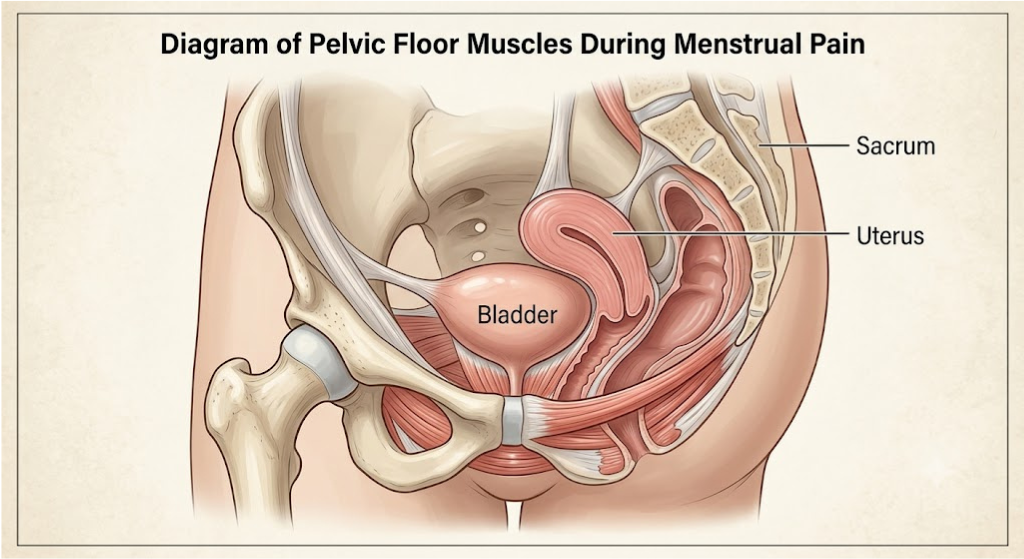
Here’s the mechanism, without the textbook language. Right before your period, your uterus releases prostaglandins to help shed its lining. That rise is the engine behind most pelvic floor spasms during period cycles. Those same chemical messengers don’t stay in one lane. They also reach the pelvic floor muscles that cradle your uterus, bladder, and rectum, and they can make those muscles clench along with the uterus.
Add in a normal drop in estrogen right before your period, and muscles that were already a little more reactive get pushed further into guarding mode. This is why the muscle tightness of pelvic floor spasms during period bleeding can feel stubborn. Some women feel this mostly as vaginal tightness. Others feel it as rectal cramping, which explains why period-related anal spasms are common enough to have their own medical name.
Stress plays a part too. It amplifies pelvic floor spasms during period days even when the cause is hormonal. If you’re the type of person who clenches your jaw or shoulders under pressure, there’s a decent chance you clench your pelvic floor the same way, and your period simply turns up the volume on a pattern that was already there.
Spasms vs. Regular Period Cramps: How to Tell the Difference
I used to lump every kind of period pain into one bucket until a pelvic floor physical therapist walked me through the difference. She explained pelvic floor spasms during period pain by pointing out where the grip sits. Here’s what actually separates the two.
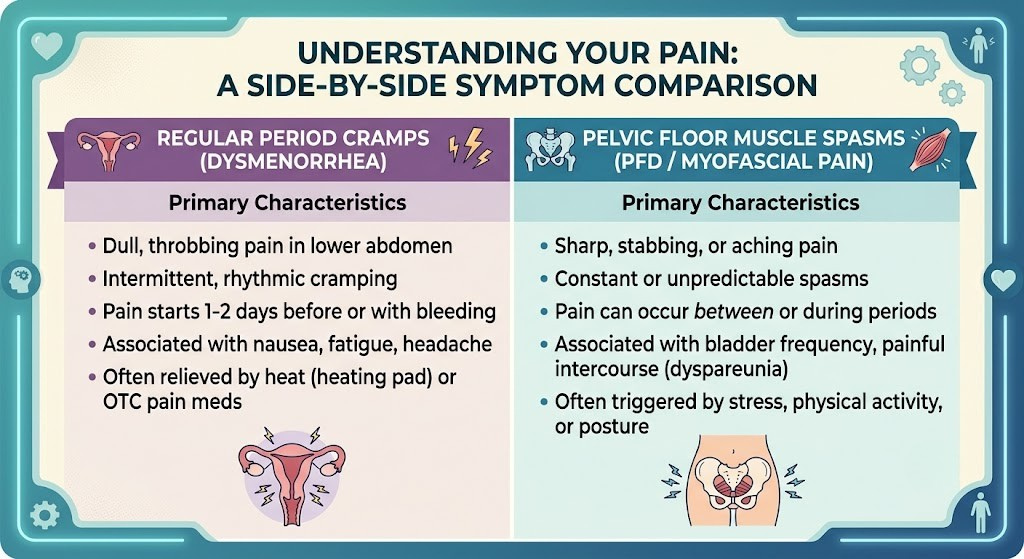
- Location: Regular cramps sit centrally in the lower abdomen. Pelvic floor spasms sit lower and feel more localized, often vaginal, rectal, or right behind the pubic bone.
- Sensation: Cramps feel like a dull, rolling ache. Spasms feel like a sharp grip or clench that comes on fast.
- Duration: Cramps ebb and flow over hours. Spasms tend to hit in short, intense bursts, sometimes just a few seconds, sometimes up to 20 minutes.
- Trigger pattern: Cramps track closely with bleeding. Spasms can show up before your period even starts, around ovulation, or randomly during the luteal phase.
- What helps: Cramps usually respond to NSAIDs and heat. pelvic floor spasms during period Pelvic floor spasms during period episodes often need relaxation techniques on top of NSAIDs and heat. Spasms often need pelvic floor relaxation techniques on top of that, since the muscle itself needs to release, not just the inflammation.
Conditions That Make Pelvic Floor Spasms Worse
Occasional spasms during your period are common and usually not a red flag on their own. Even so, many people first realize they are having pelvic floor spasms during period weeks only after learning the term. But a few underlying conditions can make them more frequent or more intense, and it’s worth knowing the list so you’re not blindsided.
Endometriosis is the big one. It is a major driver of pelvic floor spasms during period cycles because of the inflammation it causes nearby. When tissue similar to the uterine lining grows outside the uterus, it can inflame nearby structures, including the pelvic floor, which makes muscle spasms more likely during your cycle. If your periods regularly knock you off your feet, this is worth raising with your provider, and our guide to why does my uterus hurt can help you decide if your symptoms match.
Pelvic inflammatory disease and uterine fibroids can also drive up pelvic floor tension. Both can turn mild pelvic floor spasms during period days into something far more intense, since both create extra irritation and pressure in the same general area.
A weak or poorly coordinated pelvic floor matters too. The pelvic floor muscles described by Cleveland Clinic form a sling that supports your uterus, bladder, and rectum, and if they are not coordinating well, the sling can tug and tighten when your cycle changes. That is one reason pelvic floor physical therapy focuses on coordination, not just strength.
Chronic stress and anxiety deserve a mention as well. They keep the clench of pelvic floor spasms during period time alive even between cycles, since they keep the pelvic floor in a low-grade clenched state even outside your period, giving hormonal spasms less room to release.
What Actually Helps: Relief That Works
This is the part I wish someone had handed me years earlier. Some of these are things you can do tonight, and some take a few weeks to show results.
For an active spasm:
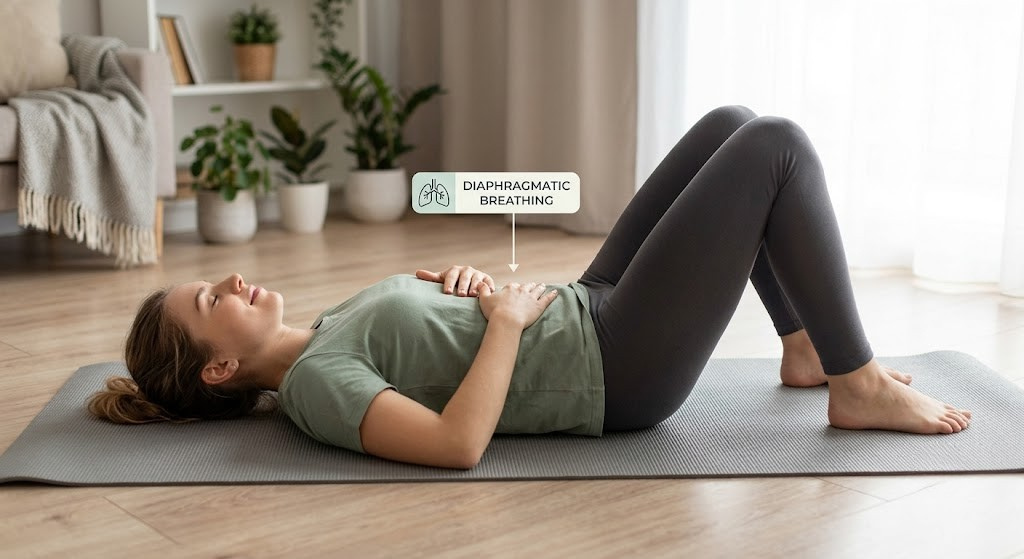
- Lie on your back with your knees bent and feet flat, or prop your feet up against a wall to take pressure off the pelvis.
- Apply heat directly over the lower abdomen and perineum. Warmth is the first line for most pelvic floor spasms during period nights. A heating pad works, and yes, a bag of frozen peas wrapped in a towel can help too by reducing swelling first before you switch to heat.
- Breathe low into your belly instead of your chest. Long exhales signal your nervous system to unclench, and the pelvic floor tends to follow.
- Avoid clenching your glutes or bearing down, which is a common reflex that actually tightens the pelvic floor further.
For prevention across your cycle:
- Diaphragmatic breathing daily, even for five minutes. It retrains the muscle behind pelvic floor spasms during period episodes to release instead of guard, trains the pelvic floor to release instead of guard.
- Gentle stretching like child’s pose, deep squats, or happy baby pose during the week before your period can keep the area from getting overly tight.
- NSAIDs like ibuprofen, taken a day or two before your period starts. They blunt the prostaglandin surge that ignites pelvic floor spasms during period mornings, if your provider has cleared this for you, can blunt the prostaglandin surge before it triggers spasms.
- Pelvic floor physical therapy is the option that made the biggest difference for me personally. It is also the gold standard when pelvic floor spasms during period pain refuses to settle at home. A therapist can check whether your pelvic floor is too tight, too weak, or both, since the treatment for each is different.
- Vaginal wands or dilators, used under guidance from a pelvic floor therapist, can help release trigger points for people with more stubborn tension.
Worth being honest about the trade-offs here. Breathing and stretching are free but slow, and you have to stick with them for real change. Physical therapy works faster for a lot of people but costs money and time, and not every insurance plan covers it well. NSAIDs help quickly but aren’t a long-term fix if the underlying muscle tension never gets addressed.
When to See a Doctor
Most pelvic floor spasms during your period are uncomfortable rather than dangerous. Even the stubborn kind of pelvic floor spasms during period nights usually responds to the right tool. That said, get evaluated if you notice any of the following:
- Pain severe enough to make you miss work, school, or normal plans
- Spasms that also show up outside your period or keep getting worse over time
- Pain during sex, urination, or bowel movements alongside the spasms
- Heavy bleeding on top of the pain
- Any pain that doesn’t respond at all to heat, rest, or over-the-counter medication
A provider can rule out endometriosis, fibroids, or pelvic floor dysfunction, and can refer you to a pelvic floor physical therapist if that’s the right next step.
Why Pelvic Floor Spasms During Period Often Start Before the Bleeding
One of the least obvious features of pelvic floor spasms during period time is that they often announce themselves a day or two before you actually start bleeding. The reason is timing: prostaglandins begin rising during the late luteal phase, right before menstruation, and that hormonal nudge can start twitching the pelvic floor before the uterus ever begins its visible shedding.
This early warning is actually useful. If you know that pelvic floor spasms during period week tend to appear on day 27 or 28 of a typical cycle, you can start your breathing routine and heat a day ahead, which blunts the spasm rather than chasing it. Many people find the premenstrual spasm window is shorter and easier to manage than the cramps themselves.
Tracking apps and simple calendar notes both work for this, as long as you record not just bleeding days but the days you felt that low, gripping tightness. Over two or three cycles the pattern becomes obvious, and you can plan around it the same way you already plan around your period itself.
A Step by Step Routine for Pelvic Floor Spasms During Period Nights
When a spasm hits at night, a simple routine helps most people unwind it without reaching for the medicine cabinet first. Start by lying on your back with your knees bent and a pillow under your thighs, then place a heating pad over your lower belly and perineum for ten minutes. This warms the tissues and begins to quiet the protective clench.
Next, switch your attention to your breathing. Inhale slowly through your nose and let your belly rise, then exhale twice as long through pursed lips. Long exhales are the fastest signal you can send to a hyperactive pelvic floor to release. Try ten cycles of this breath while keeping your shoulders and jaw soft, and you will often feel the spasm loosen within a few minutes.
Finally, do nothing else. Avoid bracing your stomach, squeezing your glutes, or jumping up to find a bathroom, all of which fight the relaxation you just built. If the spasm returns, repeat the heat and breath sequence rather than adding more interventions, because layering stress on top of a spasm is the one thing that reliably makes it worse.
How Long Do Pelvic Floor Spasms During Period Actually Last
Individual episodes are short. A single pelvic floor spasm during period time usually lasts a few seconds to about twenty minutes, and most people feel the tightness fade within the first minute or two of relaxation techniques. The broader pattern, however, can recur for a day or two on either side of your period, which is what makes it feel like a longer problem than any single episode.
The distinction matters because it changes your strategy. Short episodes respond to fast tools like breathing, heat, and NSAIDs taken before the surge. A pattern that stretches across several days usually responds better to longer-term changes like daily diaphragmatic breathing, gentle stretching, and addressing stress, because you are reducing how reactive the muscle is in the first place.
If your “episodes” last for hours without releasing, or if the pain is constant rather than episodic, that is no longer a classic spasm pattern. Constant unrelenting tightness or pain deserves an evaluation, because it may point to something like pelvic floor dysfunction, endometriosis, or a nerve irritation that needs a professional look.
FAQs
What does a pelvic floor spasm feel like during your period? It feels like a sudden, gripping tightness low in the vagina, rectum, or right behind the pubic bone, closer to a charley horse than a typical cramp. It can last a few seconds or up to 20 minutes and often starts before bleeding does.
Can pelvic floor spasms happen with a normal period, or does it always mean something is wrong? They can happen even with an otherwise normal cycle, since prostaglandins affect the pelvic floor along with the uterus. Frequent, severe, or worsening spasms are the pattern worth getting checked, not an occasional one.
Is it your uterus or your pelvic floor that’s spasming? Often both. Uterine contractions trigger the shedding of the lining, and prostaglandins from that process spread to nearby pelvic floor muscles, which can spasm in response.
Can pelvic floor exercises make period-related spasms worse? Traditional Kegels can, if your pelvic floor is already too tight rather than too weak. That’s why a proper evaluation matters before starting any pelvic floor exercise routine.
How long do pelvic floor spasms during a period usually last? Individual episodes typically last anywhere from a few seconds to about 20 minutes, though the overall pattern of spasms can recur for a day or two around your period.
Do tampons or menstrual cups make pelvic floor spasms worse? For some people with a very tight pelvic floor, insertion can be uncomfortable during a spasm-prone window. Switching to pads temporarily or trying a softer cup can help until symptoms settle.
Is it dangerous to feel pelvic floor spasms during period week? Not by itself. Occasional pelvic floor spasms during period time are common and harmless, especially if they respond to heat and breathing. What needs checking is a pattern that gets worse, spreads to non-period days, or comes with heavy bleeding or severe pain.
Can stress make pelvic floor spasms during period worse? Very much so. Stress keeps your pelvic floor in a guarded, low-grade clenched state, so when the hormonal spike of your period arrives, there is less room for the muscle to release. Managing stress with breath and movement often shrinks both the frequency and intensity of the spasms.
Should I do Kegels for pelvic floor spasms during period? Only after you know whether your floor is tight or weak. If it is already too tight, traditional Kegels can fuel more spasming. A pelvic floor assessment tells you which direction you need, so skip the guesswork and get evaluated first.
Conclusion
Pelvic floor muscle spasms during your period are more common than most conversations let on, and they’re not something you have to just push through every month. Once you can tell them apart from regular cramps, the relief options actually make sense, and a lot of them start working within one cycle.
Use your period calculator to note which days the spasms cluster around, and pair that log with a symptom note about when heat or breathing helped most. Over a couple of cycles you will see a pattern, and a pattern is what you and your doctor can actually work with.