
Take this period quiz before you read another word of this article, because I guarantee it will humble you a little. I run a cycle tracking site for a living, and I still got two questions wrong the first time I took it.
That is really the whole point of this piece. Most of us learn about periods once, around age twelve, from a pamphlet or a rushed conversation, and then we just wing it for the next few decades. This period quiz is a fast, no email required way to check what actually stuck, and it pairs well with our guide to common menstrual symptoms.
Take the Period Quiz
Answer all eight questions in this period quiz below. Each one tells you why the answer is right the moment you pick it, so you are not just guessing into a void. Whatever you score, the explanations are where the real learning happens.
Why I Thought I Knew My Own Cycle (And Didn’t)
I built a period calculator for a living before I actually sat down and learned how my own cycle worked. That sounds backwards, but I don’t think it’s unusual, and taking this period quiz is exactly the kind of ego check I needed back then.
For years I assumed 28 days was the standard and mine was just being difficult when it ran closer to 32. I also fully believed the roommate-syncing thing, because it seemed to happen to my college suite, and I never questioned it again after that.
Key takeaway: A 28-day cycle is an average across millions of people, not a target your own body needs to hit. Anywhere from 21 to 35 days is considered typical, and it’s the first fact any period quiz should teach you.
Writing the questions for this quiz meant going back through the research instead of my own assumptions, and a few of the answers genuinely surprised me. That’s the section below.
What Actually Counts As a Normal Period
A normal period falls within a cycle of 21 to 35 days, with bleeding that lasts 2 to 7 days. Anything consistently outside that range, or a big shift from your own usual pattern, is worth mentioning to a doctor rather than just tracking quietly. If you’re not sure where you stand, our free period calculator can show you your expected cycle window.
That range is wide on purpose. Cycle length isn’t fixed the way a lot of health class diagrams make it look. Age, body weight, and stress all play a role, and research from large cycle-tracking studies has found real, measurable differences across these factors, not just anecdotal ones. That variability is exactly why a one-off score on a period quiz matters less than your own month-to-month pattern.

The Part of Your Cycle Nobody Talks About
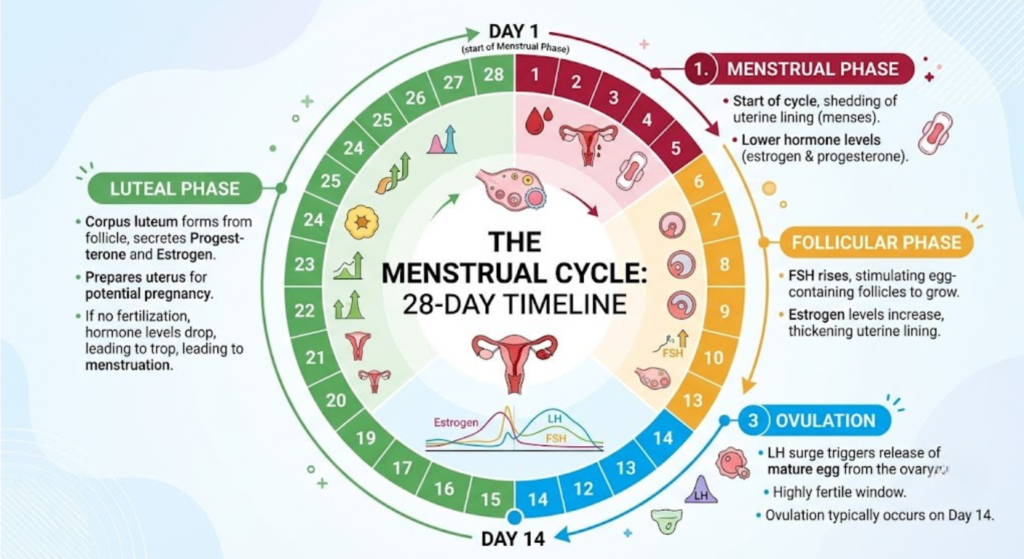
Most period education stops at “you bleed, then it’s over, then it starts again.” What usually gets skipped is that a cycle has four distinct phases, and they don’t behave the same way. A good period quiz tests you on these phases, and most people miss at least one.
The stretch before ovulation, called the follicular phase, is genuinely variable. It can run short one month and long the next depending on stress, illness, travel, or nothing at all. The stretch after ovulation, the luteal phase, is a different story. It tends to sit close to 14 days with far less month-to-month swing.
This is actually useful information, not just trivia. If your cycle length is changing, it’s almost always the first half doing the shifting, not the second. That one insight is worth more than a perfect period quiz score.
Period Myths That Still Trip Everyone Up
A few beliefs keep showing up in DMs, group chats, and honestly my own head before I fact-checked them. Some of them even made it into this period quiz as wrong answers, because that’s how common they are.
- Periods sync up between friends or roommates. There’s no solid research backing this. It looks true because most cycles land in a similar range to begin with.
- You can’t get pregnant on your period. It’s less likely, but not impossible, especially with a shorter cycle where ovulation happens earlier than usual.
- PMS is the same thing as PMDD. PMS is common and mild to moderate. PMDD is a more severe mood-related condition that affects daily functioning and usually needs a doctor’s involvement. The Mayo Clinic draws the same distinction.
- A missed period always means pregnancy. Stress, big weight changes, intense exercise, and certain medical conditions can all stop a period on their own. Our breakdown of the signs your period is coming late walks through the usual causes.
- Tracking apps are always accurate. They’re a helpful pattern-spotter, not a guarantee, especially if your cycle is irregular or you’re inconsistent about logging.
When Your Cycle Is Trying to Tell You Something
Doctors now treat the menstrual cycle as an actual health signal, not just a monthly inconvenience, and this period quiz is built around that same idea. The American College of Obstetricians and Gynecologists has recommended tracking cycle patterns as a vital sign since 2015, and reaffirmed that guidance again in 2025, especially for teenagers whose cycles are still settling into a pattern.
A 2025 viewpoint published in The Lancet’s obstetrics and gynaecology journal made a similar case for adults, arguing that cycle changes can flag health issues well before other symptoms show up. It’s the kind of research that makes this period quiz feel less like a game and more like a useful first check.
A few things worth an actual doctor’s visit, not just a note in your tracking app:
- Soaking through a pad or tampon every hour for several hours in a row.
- A cycle that’s consistently shorter than 21 days or longer than 35.
- Periods that stop for three or more months without pregnancy.
- Pain severe enough to interfere with work, school, or daily plans.
What to Do With Your Score
If this period quiz above caught you off guard the way it caught me, the fastest fix isn’t reading more articles. It’s actually watching your own cycle for a cycle or two.
If you’ve noticed something like two periods in one month, that’s a specific enough pattern that it’s worth reading about on its own rather than guessing. Otherwise, our free period calculator will do the tracking for you and flag when something drifts outside your normal range.
How to Retake This Period Quiz and Actually Improve
If your score surprised you, don’t just walk away from it. Use the next cycle or two to close the gaps, then retake this period quiz and watch the number climb.
Start by tracking your cycle start and end dates for two full months. A tracking app is fine, but a simple calendar works just as well. The data is what matters, not the tool you use to collect it.
Next, write down your symptoms each day: cramps, mood, sleep, energy, and flow level. Patterns you never noticed show up fast once you stop relying on memory and start writing things down.
Finally, retake the period quiz above at the end of those two months. Most people score noticeably higher on the cycle-length and symptom questions the second time around, simply because they finally have real data.
FAQs
What is considered a normal period? A cycle of 21 to 35 days with bleeding lasting 2 to 7 days is considered typical. The exact numbers vary person to person, so your own normal matters more than the textbook average. This might be the single most useful answer a period quiz can give you.
Doctors usually look at three things together: cycle length, number of bleeding days, and how much variation you see month to month. Small shifts of a day or two are completely normal. Large swings, like going from 24 days one month to 35 the next, are what deserve closer attention.
Why do periods vary so much from person to person? Cycle length is shaped by age, body weight, stress, and overall health, and research has found measurable differences across all of these. No two people should expect identical cycles, which is also why a period quiz never has one answer that fits everyone.
Age matters more than most people expect. Cycles in the first few years after periods begin can be long and irregular, and they tend to become more variable again in the years before menopause. In between, most people settle into a fairly repeatable rhythm.
Do periods really sync up between people who live together? Not based on current research. It’s a common belief, but studies haven’t found solid evidence for it. Cycles just happen to fall in a similar range to begin with.
What often looks like syncing is really just overlap. Two people with cycles in the same 28 to 35 day range will naturally hit the same week occasionally, and our brains remember those coincidences far better than all the months the cycles didn’t line up.
How accurate are period tracking apps? They’re good at spotting your personal pattern over time, but they’re a prediction tool, not a guarantee. Irregular cycles or inconsistent logging both reduce their accuracy. For most people, a period quiz plus a good tracking app beats either one alone.
Logging consistently is the single biggest factor in app accuracy. Missing a day here and there is fine, but long gaps create guesswork. If you only open the app a few days per month, a simple paper chart gives you about the same result.
When should I see a doctor about my period? See a doctor for heavy bleeding that soaks through protection hourly, a cycle consistently outside 21 to 35 days, periods that stop for three or more months without pregnancy, or pain that disrupts daily life.
Many people also wonder whether new spotting between periods matters. Spotting is common and usually harmless, but if it keeps happening for several months, it’s worth mentioning at your next visit rather than brushing it off.
Can stress or diet actually change my cycle? Yes. Significant stress, rapid weight changes, and intense exercise can all delay ovulation or skip it entirely, which shifts or skips a period.
The good news is that these changes are usually reversible. Once stress drops, weight stabilizes, or training load evens out, most people see their cycle return to its previous pattern within a couple of months.
Three Cycle Facts This Period Quiz Keeps Getting Right
Some parts of cycle education seem to change every few years, so it helps to know which facts are actually solid. These three show up again and again in real tracking data and medical guidance.
First, the fertile window is not a fixed set of days. Sperm can survive inside the body for up to five days, which means ovulation timing only gets you so far on its own.
Second, cycle length naturally changes with age. Teens and people in their forties often see more variation, while the late twenties and thirties tend to be the most regular years for most people.
Third, bleeding is not the whole story. The luteal phase, the stretch between ovulation and the next period, stays fairly consistent at around 12 to 14 days for most people, even when the overall cycle length shifts. That consistency is one reason a period quiz can predict a due date so well.
What Your Period Quiz Score Actually Means
A single score only measures what you know right now, not how well your body behaves. Someone with a perfect period quiz score can still have irregular cycles, and someone who scores low can be completely healthy.
Treat the quiz above like a warm-up for your own observations. The questions are a checklist of the things worth paying attention to: cycle length, flow, symptoms, and timing. Once you know which questions you can’t answer confidently, you know exactly where to focus your tracking.
That is the real value of this period quiz. It turns a vague feeling of “I should understand my body better” into a specific list of facts to learn and patterns to watch.
Signs This Period Quiz Points Forward to
A few of the questions in the quiz above point to the week before bleeding, and recognizing those early clues can make your tracking much easier. If you know what usually shows up first, you can spot it sooner and log it.
Many people notice breast tenderness, bloating, or a shift in appetite a week before the period arrives. These are driven by the natural drop in hormones after ovulation and rank among the earliest signals your body gives.
Mood changes and trouble sleeping are just as common but easier to brush off as a bad week. If the same emotional pattern lands in the same part of your cycle for two or three straight months, it is worth writing down.
A slight drop in energy and lighter focus in the days before bleeding is typical, not a sign you are doing something wrong. Pairing these clues with a simple calendar is all most people need.
For a more exact forecast built from your own dates, the global period calculator calculates your expected start dates for the next several cycles. Combine it with the quiz above and you have both the big picture and the detail.
Conclusion
A period quiz sounds like a small thing to spend five minutes on, but most of us are running on secondhand facts from a decade or two ago. Getting even a couple of questions wrong here isn’t a failure, it’s just a sign that nobody ever handed you an update. Retake this period quiz after a few months of tracking and you’ll be surprised how much your score improves.
The whole point of a quiz like this one is to give you a starting line, not a finish line. The more you track, the clearer your own answers become.
The truth is that most period education is taught once and never revisited. Hormones change, research updates, and your own body changes with them. A single round of questions is a snapshot, not a verdict.
Keep this page handy for the days your body feels like a mystery. Take the period quiz above, compare your answers with what you actually observe, and let the gaps tell you what to track next.
CTA
Take the period quiz again in a few months once you’ve been tracking, and see if your score changes. Then let your actual cycle data do the rest of the work with our free period calculator.
And if the quiz above made you realize you’re overdue for a proper check-in with your cycle, that’s a completely reasonable place to start. Knowing your pattern is the first step, and the calculator below turns your dates into a clear, forward-looking forecast.
Disclaimer :This period quiz and article are for general educational purposes only and are not a substitute for professional medical advice, diagnosis, or treatment. If you have concerns about your menstrual cycle, talk to a qualified healthcare provider.