
Author Note: Reviewed for accuracy against current OB-GYN and Mayo Clinic guidance. This article is written from research and personal tracking experience, not as a substitute for a clinical exam.
Table of Contents
- What Is Bacterial Vaginosis
- What Is a Yeast Infection
- Bacterial Vaginosis vs Yeast Infection: The Quick Answer
- Symptoms Side by Side
- What Causes Each One
- Can You Have Both at the Same Time
- How Doctors Actually Diagnose It
- Treatment Options
- Why Tracking Your Cycle Makes This Easier to Spot
- When to See a Doctor
- How to Lower Your Risk
- FAQs
- Conclusion
Bacterial vaginosis vs yeast infection confusion is more common than most people admit, and I learned that the hard way three years ago when I spent forty dollars on an over the counter yeast cream that did absolutely nothing.
Turns out I had BV the whole time. My doctor laughed a little, not unkindly, and told me almost every woman she sees has made the same mistake at least once.
That mix up happens because both conditions live under the same umbrella. Doctors call it vaginitis, which just means irritation of the vagina. The symptoms overlap enough that guessing wrong is easy, and the treatments are completely different, so guessing wrong actually matters.
What Is Bacterial Vaginosis
Bacterial vaginosis, or BV, happens when the natural bacteria balance in your vagina tips out of whack. Your vagina normally hosts a colony of good bacteria called lactobacilli that keep everything slightly acidic and calm.
When that balance shifts and bad bacteria like Gardnerella start to outnumber the good ones, BV shows up. It is not caused by poor hygiene, and it is not technically an STI, though sexual activity can trigger it in some people.
Here is the part that surprised me most. Up to 84 percent of women with BV have no symptoms at all. So if you have ever had an odd test result with no discomfort, that tracks.
What Is a Yeast Infection
A yeast infection is a fungal overgrowth, usually of a species called Candida albicans. That fungus lives on your body already in small amounts, and your vaginal flora normally keeps it in check.
Stress, antibiotics, uncontrolled blood sugar, hormone shifts, or a weakened immune system can let Candida multiply past its usual limits. Once that happens, the itching starts, and it does not let up easily.
About three out of four women will deal with a yeast infection at some point. If you have had one, you already know the itch is impossible to ignore.
Bacterial Vaginosis vs Yeast Infection: The Quick Answer
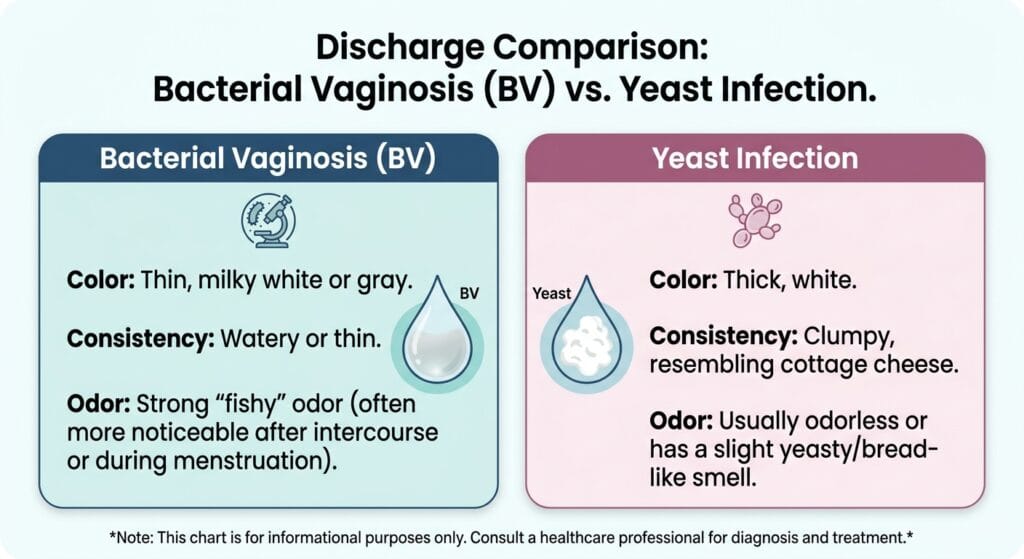
BV causes thin, gray or white discharge with a strong fishy smell and little to no itching. A yeast infection causes thick, white, clumpy discharge that looks like cottage cheese, with intense itching and almost no odor. Discharge texture and smell are your two biggest clues.
| Feature | Bacterial Vaginosis | Yeast Infection |
|---|---|---|
| Cause | Bacterial imbalance | Fungal overgrowth (Candida) |
| Discharge | Thin, gray or white, watery | Thick, white, clumpy |
| Smell | Strong, fishy, worse after Intercourse | Usually odorless |
| Itching | Mild or absent | Intense |
| Pain during intercourse or urination | Sometimes | Common |
| Treatment | Prescription antibiotics | OTC or prescription antifungals |
| Is it an STI | No | No |
Key takeaway: If the smell bothers you more than the itch does, think BV. If the itch is unbearable and the discharge looks like cottage cheese, think yeast infection.
Symptoms Side by Side
I keep a mental checklist now, and it has saved me a couple of unnecessary drugstore trips.
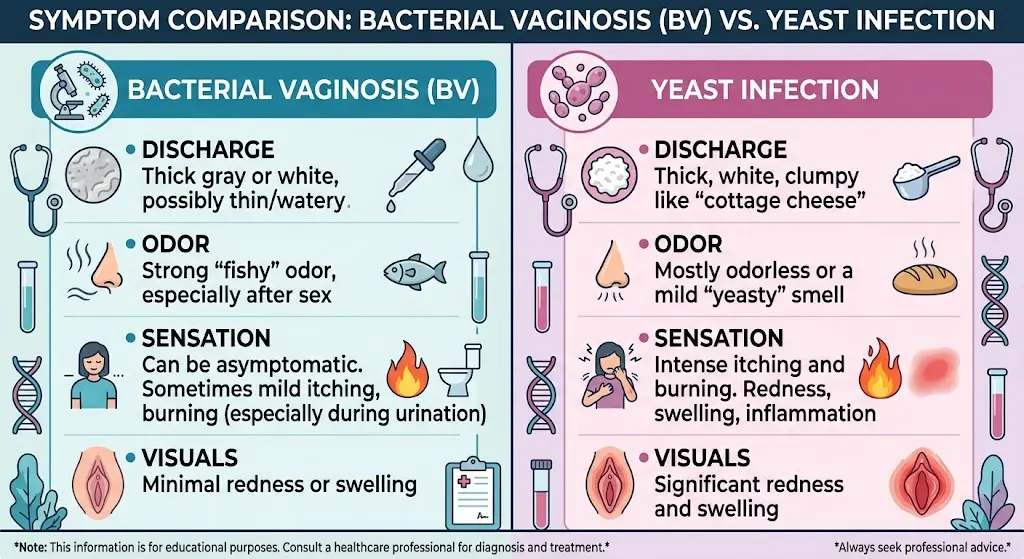
Bacterial vaginosis symptoms usually include:
- Thin, watery discharge that is gray, white, or slightly greenish
- A fishy odor, especially noticeable after intercourse or during your period
- Mild burning during urination in some cases
- Very little to no itching
Yeast infection symptoms usually include:
- Thick, white, clumpy discharge with a cottage cheese texture
- Intense itching and redness around the vulva
- Burning during intercourse or urination
- Swelling of the vaginal opening
What Causes Each One
BV tends to show up after things that disrupt your natural pH, like douching, a new Relationship partner, unprotected romence, or even a recent course of antibiotics. Smoking is also linked to higher BV rates.
Yeast infections have a different trigger list. Antibiotics can wipe out the good bacteria that normally keep Candida in check, which is why a yeast infection right after a round of antibiotics is so common. Pregnancy, birth control with higher estrogen, uncontrolled diabetes, and tight, non breathable underwear all raise your risk too.
Can You Have Both at the Same Time
Yes, and it happens more than people realize. Researchers have found that recurrent BV can actually make you more prone to yeast infections afterward, because the inflammation BV causes disrupts the vagina’s natural yeast tolerance. If your symptoms feel like a strange mashup of both lists, a mixed infection is a real possibility, and it is one more reason self diagnosing from a blog post has its limits.
How Doctors Actually Diagnose It
A provider will usually do a quick pelvic exam and take a sample of your discharge. From there they check three things: the pH level, what the sample looks like under a microscope, and sometimes a quick smell test using a specific solution. This whole process takes about ten minutes and is far more reliable than guessing at home.
Treatment Options
For BV, you will need prescription antibiotics, usually metronidazole or clindamycin, taken orally or as a vaginal gel. There is no reliable over the counter fix for BV, and using a yeast infection product on BV can actually make things worse.
For a yeast infection, over the counter antifungal creams or suppositories work for many mild cases. A single dose oral antifungal like fluconazole is another common option if your doctor prescribes it. If your yeast infections keep coming back four or more times a year, that pattern is worth a deeper conversation with your provider.
Why Tracking Your Cycle Makes This Easier to Spot
Here is something most articles on this topic skip entirely. Your discharge naturally changes throughout your cycle, and knowing where you are in that cycle makes it much easier to notice when something is actually off.
I started logging my cycle on www.Freeperiodcalculator.com mostly to predict my next period, and I noticed almost by accident that my “normal” discharge pattern shifted around ovulation every month. That baseline made it obvious the week my discharge suddenly turned watery and started smelling different. I wasn’t guessing anymore. I had a pattern to compare against.
If you want to build that same baseline, the [Free Period Calculator INTERNAL LINK: link to cycle tracking guide] can help you track your cycle alongside symptoms like discharge changes, so patterns like this stand out faster instead of catching you off guard.
When to See a Doctor
Book an appointment if any of these apply to you:
- This is your first time having these symptoms
- Symptoms last more than a week
- You are pregnant
- Home treatment has not worked
- You have a fever along with the discharge change
- Infections keep coming back
Untreated BV during pregnancy has been linked to premature delivery, so pregnant readers should not wait this one out.
How to Lower Your Risk
- Skip douching completely, your vagina cleans itself
- Wear breathable cotton underwear
- Change out of wet swimsuits or workout clothes quickly
- Avoid scented soaps, sprays, and bubble baths near the vulva
- Wipe front to back
- Consider a probiotic if you get recurrent BV, after checking with your doctor
FAQs
Can BV go away on its own? Mild cases sometimes clear up without treatment, but many do not. Since untreated BV raises your risk for other infections, it is safer to get it checked rather than wait it out.
Does a yeast infection smell? Not usually. A strong odor almost always points toward BV instead, since yeast infections are typically odorless.
Can men get BV or yeast infections? Men do not get BV the way women do, but they can carry and pass along the bacteria involved. Men can get yeast infections, though it is less common.
Is it safe to use a yeast infection cream if I’m not sure what I have? No. Using the wrong product can delay real treatment and sometimes make BV symptoms worse. A quick pH test at home or a doctor visit is a better first step.
Why do I keep getting BV after my period? Menstrual blood raises vaginal pH temporarily, which can create conditions BV bacteria like. Tracking your cycle helps you anticipate and manage this pattern.
Conclusion
Bacterial vaginosis and a yeast infection can feel almost identical in the moment, but the discharge texture, the smell, and the itch level usually point you in the right direction. BV leans watery, gray, and fishy smelling with little itch. A yeast infection leans thick, white, and intensely itchy with barely any smell. When you are not sure, or symptoms stick around, a quick visit to your provider beats guessing every time.
- CTA: Want to catch changes like this earlier next time? Track your cycle for free at www.Freeperiodcalculator.com and start noticing your body’s normal pattern before something feels off.
Disclaimer: This article is for general educational purposes only and is not a substitute for professional medical advice, diagnosis, or treatment. Always consult a licensed healthcare provider about your specific symptoms before starting any treatment.