
The first time I actually understood what the follicular phase is, I was three months into tracking my cycle on a notes app and trying to figure out why week two always felt like a completely different version of me. More energy. Better skin. Actual motivation to go to the gym instead of just thinking about it.
Turns out that was not a coincidence. It had a name, and a whole cast of hormones behind it.
What Is the Follicular Phase?
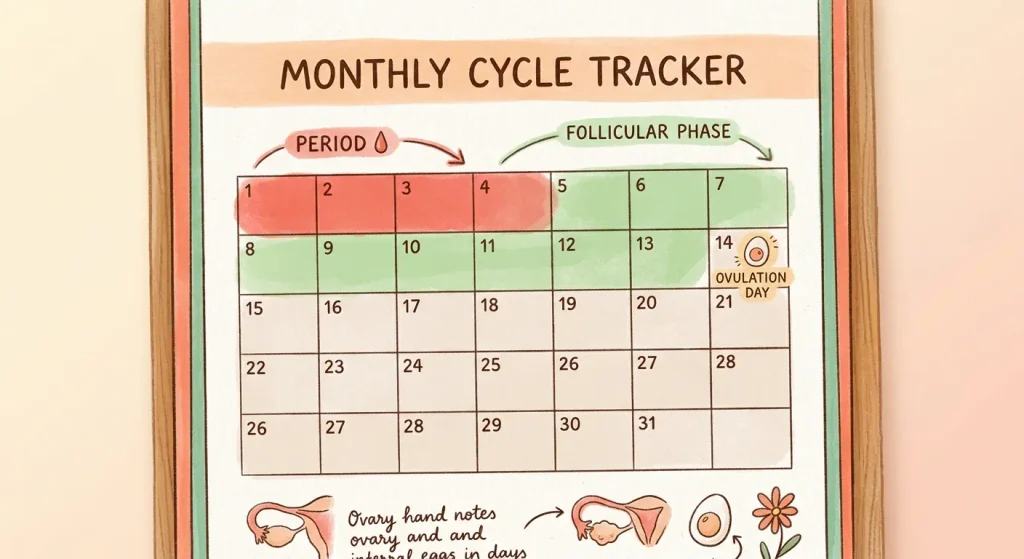
The follicular phase is the first phase of your menstrual cycle, starting on day one of your period and ending the moment you ovulate. During this stretch, your brain and ovaries work together to mature a single dominant egg while rising estrogen rebuilds your uterine lining.
According to Cleveland Clinic, doctors sometimes call it the preovulatory phase or the proliferative phase, because your uterine lining is literally proliferating (thickening) the entire time this is happening. It is also the phase most fertility trackers and apps, including a free period calculator, use as the starting point for every prediction they make about your cycle.
Key takeaway: The follicular phase is not a side event. It is the foundation your entire cycle is built on, and it directly determines when you ovulate.
How Long Does the Follicular Phase Last?
This is where most people get surprised. The follicular phase is the longest and most variable phase of the menstrual cycle. In a textbook 28-day cycle it runs about 14 to 16 days, but according to research summarized by the National Library of Medicine, real-world ranges stretch from roughly 11 to 21 days, and sometimes longer.
Compare that to the luteal phase (the second half of your cycle, after ovulation), which usually holds steady at around 12 to 14 days no matter what. So if your cycle length changes from month to month, the follicular phase is almost always the phase doing the shifting, not the luteal phase.
That single fact explains a lot. If your period tracker keeps predicting ovulation on the wrong day, the follicular phase is usually why.
What Happens During the Follicular Phase
Here is the short version of the biology, without the textbook language.
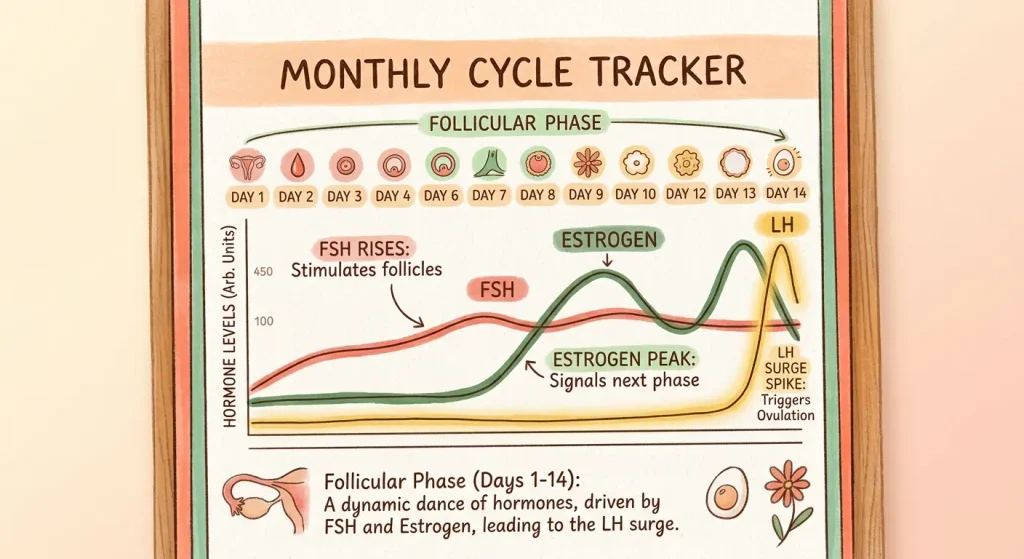
Your follicle-stimulating hormone (FSH) rises first, right around the start of your period. It tells your ovaries to wake up a batch of small follicles, each holding an immature egg.
Over the next week or two, one follicle pulls ahead of the pack and becomes dominant. As it grows, it pumps out estrogen, which does two jobs at once:
- Rebuilds the uterine lining your body just shed
- Thins and clears your cervical mucus so sperm can travel more easily later on
Near the end of the phase, estrogen peaks high enough to trigger a surge of luteinizing hormone (LH). That LH surge is what actually causes ovulation, releasing the mature egg and closing out the follicular phase for the month.
Follicular Phase Symptoms: Early vs. Late
Symptoms genuinely shift as the phase goes on, which is part of why it can feel like two different phases stitched together.
Early follicular phase (during your period):
- Cramping and bloating
- Lower energy
- Breast tenderness for some people
- Mood dips for some, steady mood for others
Late follicular phase (as ovulation approaches):
- Rising energy and motivation
- Clearer, stretchier cervical mucus
- Improved mood for many people
- Higher libido for some
Not everyone notices a dramatic shift, and that is normal too. Hormone sensitivity varies a lot from person to person, and things like hormonal birth control can flatten these patterns almost entirely.
How to Track Your Own Follicular Phase
I started tracking mine the boring way, with a paper calendar and a pen, mostly because I wanted to stop being blindsided by my period. What I actually learned had nothing to do with my period and everything to do with the two weeks before it.
Once I noticed the pattern (low energy for a few days, then a slow climb back up), planning my month got a lot easier. I stopped scheduling big presentations for day two of my cycle. I started saving harder workouts for week two.
If counting days by hand sounds like a hassle, a free period calculator does the math for you. Enter your last period start date and average cycle length, and it estimates your current phase, your fertile window, and your likely ovulation date, all in a few seconds.
For a closer read on your body’s daily signals, three tools work well alongside any calculator:
- Basal body temperature (BBT): Take it every morning before getting up. It stays lower through the follicular phase and rises slightly after ovulation.
- Cervical mucus checks: Watch it shift from dry or sticky early on to clear and stretchy as you approach ovulation.
- LH ovulation tests: These catch the hormone surge that signals ovulation is about a day or two away.
Follicular Phase vs. Luteal Phase
These two phases run the whole show, and they behave almost like opposites.
| Follicular Phase | Luteal Phase | |
|---|---|---|
| When it happens | Period through ovulation | Ovulation through next period |
| Typical length | 11 to 21 days (variable) | 12 to 14 days (fairly fixed) |
| Lead hormone | Estrogen | Progesterone |
| Common feeling | Energy builds gradually | Energy often dips before your period |
When Your Follicular Phase Is Too Short or Too Long
A follicular phase under about 10 days or over 21 days is worth a conversation with your doctor, especially if it is a new pattern for you.
Common causes of a shorter or longer follicular phase include:
- High stress or major life changes
- Significant weight changes
- Thyroid conditions
- Polycystic ovary syndrome (PCOS), which often lengthens or destabilizes this phase
- Perimenopause, as cycles naturally become less predictable
irregular periods” to your related irregular-cycle article, such as your piece on does spotting count as a period
A single off month usually is not cause for alarm. A pattern that repeats for three or more cycles is the point where it is worth getting checked out.
Follicular Phase Diet and Lifestyle Tips
None of this is required, but a few small habits genuinely make the follicular phase feel better, based on what tends to help most people.
What tends to help:
- Iron-rich foods (leafy greens, beans, lean meat) during your period to help replace what you lose
- Protein and fiber-forward meals as energy climbs in week two
- Using the natural energy boost for harder workouts, if that fits your schedule
Worth being honest about:
- No food or supplement will “fix” a hormone imbalance on its own
- Sleep and stress management usually move the needle more than diet tweaks alone
- If symptoms are severe enough to disrupt your life, that is a medical conversation, not a lifestyle one
![eaIron and protein rich foods that support the follicular phase.]](https://freeperiodcalculator.com/wp-content/uploads/2026/08/Iron-and-protein-rich-foods-that-support-the-follicular-phase-1024x559.webp?wsr)
FAQs
How long does the follicular phase last? Typically 11 to 21 days, averaging around 14 to 16 days in a standard 28-day cycle. It is the most variable phase of the menstrual cycle.
What are the signs you are in your follicular phase? Early on, period symptoms like cramping and low energy. Later, rising energy, clearer cervical mucus, and improved mood as ovulation nears.
Can you get pregnant during the follicular phase? Not in the early days, but yes in the final few days before ovulation, when cervical mucus and hormone levels are most fertility-friendly.
What causes a short follicular phase? Stress, thyroid conditions, PCOS, low body weight, or perimenopause can all shorten or destabilize this phase.
How do I calculate my follicular phase? Count from day one of your period until ovulation, or use a free period calculator to estimate it automatically from your cycle history.
Bottom Line
The follicular phase is not just the lead-up to your period ending. It is the phase that quietly sets the tone for your energy, your mood, and your fertility for the rest of the month. Once you know what to look for, the pattern becomes hard to unsee.
If you want to stop guessing where you are in your cycle, plug your dates into our free period calculator and see your current phase in seconds.
This article is for general educational purposes and is not a substitute for professional medical advice. Talk to your doctor or gynecologist about any concerns regarding your menstrual cycle.