

Do you gain weight on your period? Yes, most people gain 1 to 5 pounds in the days before and during their period, and it is almost always water, not fat. The weight shows up fast because of hormones, and it usually disappears within a week once your period ends. In short, the gain weight on your period is expected and short lived.

I noticed this the summer I started actually weighing myself every day instead of once a week. Same routine, same meals, and the scale still crept up by three pounds like clockwork every month. My jeans got tight around the same time my skin broke out. Turns out that was not a coincidence.
It took me a while to understand that this was the same reason most people gain weight on your period from one month to the next. It was not that I suddenly ate more or trained less. It was that my body briefly held onto fluid during a very predictable window, and then let it go.
Why You Gain Weight on Your Period (and Why It’s Temporary)
If you see the number climb a day or two before your period starts, that is expected, not a problem. Most of the gain weight on your period is fluid, and it reverses on its own within about a week of bleeding beginning.
The reason it happens is hormonal. Each cycle, your body briefly holds onto more water, your digestion slows a little, and your appetite rises, and together those three effects show up as a few extra pounds that feel very real in the moment.
Understanding the cause is the whole game. When you know the bump is temporary and predictable, you stop panicking at the scale and start expecting it, which is far easier on your mood and your confidence.
Why Your Period Makes You Gain Weight
Your body starts prepping for a possible pregnancy about two weeks before your period even arrives. During this stretch, called the luteal phase, progesterone rises and tells your kidneys to hold onto more sodium and water. That water has to go somewhere, and it usually settles in your belly, hands, and ankles.
At the same time, serotonin (your feel-good brain chemical) dips a little, which is part of why carbs and chocolate suddenly sound so appealing. Eating more carbs pulls in even more water, since carbohydrates are stored with water in your muscles. It is not a willpower problem. It is chemistry.
Key takeaway: Period weight gain is mostly water retention and hormone-driven appetite, not new body fat. Most of it is gone within a week.
Digestion also slows down during this window, which is why bloating feels worse than usual, according to Cleveland Clinic, which notes that hormonal changes, water retention, and other cycle-related factors can shift your weight throughout the month.
This chain of events is exactly why the number on the scale tends to climb at the same point in every single cycle. Your own data, kept over two or three months, will almost always show the same pattern, which makes it far less scary when you see it happen again.
It also explains why some months feel worse than others. If you have been eating more salt, sleeping poorly, or traveling around that time of your cycle, the water retention is a little stronger, and the scale looks a little worse, even though nothing about your body composition actually changed.
So the next time you feel yourself puffing up like clockwork, remember that your body is doing what it is supposed to do, and the change on the scale is simply the gain weight on your period you can learn to expect and plan around.
How Much Weight Is Normal
There is no single “correct” number, but here is the general range clinicians point to when people ask how much they are likely to gain weight on your period:
- 1 to 2 pounds: Very common, mild water retention
- 3 to 5 pounds: Still normal for many people, especially with more pronounced bloating
- More than 5 pounds that does not go away: Worth mentioning to your doctor
Most of this weight tends to peak right before bleeding starts and fades within a few days once your period gets going. If you are trying to guess how many pounds you will see, the average answer is usually in the same 1 to 5 pound range, and it is the same pattern nearly everyone who reports gain weight on your period describes.
Everyone has a different personal range, so your own baseline matters far more than any average. The smartest habit is to weigh yourself at the same time each morning, in the same clothes, and then watch the trend instead of obsessing over a single reading.
Using a period calculator to know exactly which phase you are in makes interpreting your numbers much easier, because you can finally see why you weigh more on certain days of the month than others.
How Long Does the Gain on Your Period Last
The good news is that the bump is short lived for almost everyone. The number usually starts to fall as soon as your period begins, and most people are back to their normal baseline within three to five days, which is exactly the timeline of a typical gain weight on your period.
Because it happens this predictably, the gain related to your period is rarely a reason to change your diet or your training. It is water moving through, not fat being stored, and your body takes care of it without any help.
The only time it deserves more attention is when the number stays elevated a week after your period ends, or when the change feels way bigger than usual. Those are better questions for your doctor than for your scale.
Why Two People Can Gain Weight on Your Period Differently
You might read a range, or compare notes with a friend or partner, and wonder why the two of you seem so different. That difference is normal, because how much someone tends to gain weight on your period depends on several personal factors working together.
How much salt you eat, how much water you drink, whether you are under stress, your sleep quality, and even your baseline hormone sensitivity all shape how much water your body chooses to hold. That is why one person sees a small two pounds and someone else sees four or five.
None of these variables mean one person is healthier than another. It simply means your own reaction is your own, which is why tracking your own numbers beats any generic average for judging what is normal for you.
So instead of asking whether you measure up to a number you read online, ask yourself whether your own weekly pattern is consistent. Consistency, not a single score, is the real sign that the gain weight on your period is business as usual.
Water Weight vs. Real Weight Gain
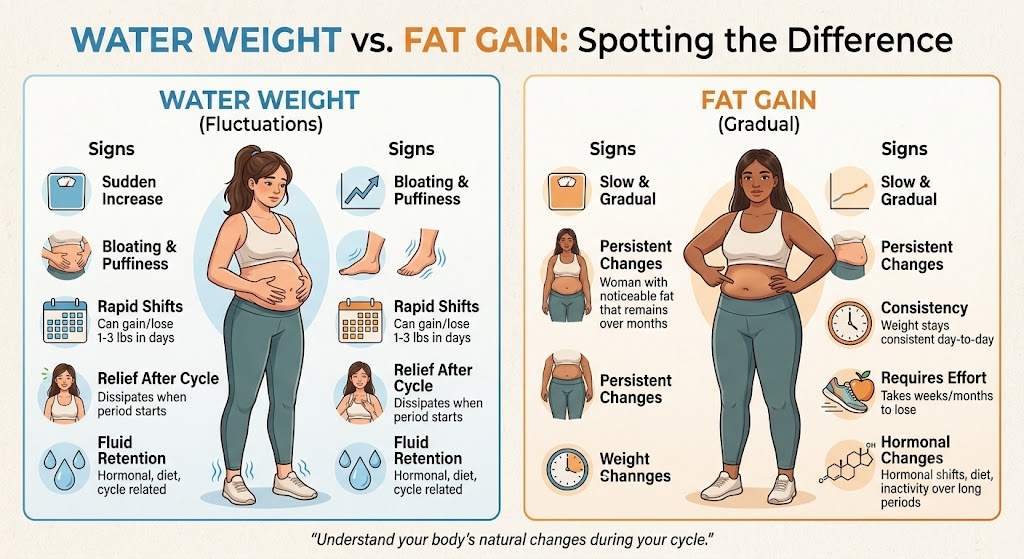
Here is a quick gut check I use every month. Water weight comes on fast, usually within a day or two, and leaves just as fast, which is the clearest sign of the kind of gain weight on your period most people feel.
Real fat gain builds slowly over weeks or months and does not reset on its own once your period ends. If the scale stays up after your period is finished, that is a signal it is probably not cycle-related bloating anymore.
To tell these apart in the moment, ask one simple question: is the number rising only during the same week each month, or is it staying up all month long? If it climbs fast, settles back, and then returns at the same point next cycle, you are almost certainly dealing with the predictable gain weight on your period.
Patience also does the work for you. Within about a week of your period ending, most of the bump has already faded on its own, without you having to change a single habit. That alone is the simplest way to confirm it was water all along.
When you stop and look back at your own logs over a few months, the pattern becomes unmistakable, and the relief comes from finally being able to name what is happening instead of guessing.
What Actually Helps
None of these will stop the hormonal shift, so you will normally still gain weight on your period a little, but they do take the edge off the bloating and discomfort.
Cut back on salty, packaged foods the week before your period. Sodium pulls in extra water, so swapping chips for something like symptom-friendly snack ideas can make a real difference.
Drink more water, not less. It sounds backward, but dehydration actually makes your body cling to fluid harder. Aim for steady sips throughout the day.
Move, even gently. A walk or light stretching gets fluid moving through your lymphatic system and can ease cramps at the same time, which is another reason light activity helps reduce the gain weight on your period. Check out gentle ideas for your period week for a few tips that will not leave you exhausted.
Add potassium-rich foods like bananas, spinach, and sweet potatoes. Potassium helps balance out sodium’s water-retaining effect.
Give the carb cravings some room, but pair them with protein so you are not eating on an empty, crash-and-craving cycle. This ties into our eating-for-your-cycle guide if you want a deeper dive.
A Quick Week-by-Week Look at Gain Weight on Your Period
Seeing the pattern on a timeline makes it easier to stop guessing. Here is roughly how the scale moves across a typical month, assuming you weigh in the same way each time.
- Week one (period days): Fluid drops and the scale trends back toward your baseline.
- Week two (follicular): Usually your lightest, most stable week of the month.
- Ovulation week: A small rise is normal as estrogen shifts.
- Week four (luteal): This is when fluid retention and the gain weight on your period peak right before bleeding.
Once you see that same little spike return in the same week each month, the whole mystery disappears and the number stops controlling how you feel about yourself.
Mistakes That Make the Number Worse Than It Is
A few everyday habits accidentally turn a normal few pounds into a reason to panic. Most of them come from reading too much into a single weigh in.
- Weighing at random times: Fluid, food, and water intake swing the number a lot within one day, so pick one time and keep it.
- Trusting one big jump: One higher morning is usually just another wave of water, not lost progress.
- Forgetting the cycle day: Without the day logged, your own numbers become impossible to read later.
Avoid these three habits and your log becomes genuinely useful, because then you can finally tell the normal, temporary bump apart from a real trend worth acting on.
How to Confirm It’s Just Period Water Fast
If you are not sure whether what you are seeing is a normal gain weight on your period or something else, there is a fast way to check. Look at whether the number follows your cycle like a habit.
Someone who tends to gain weight on your period will see the same two or three pounds appear around the same days every month, then vanish within a week. That repeated shape is the fingerprint of hormone-driven water retention.
By contrast, a real problem ignores your cycle entirely. The number climbs slowly, stays up no matter what week it is, and does not reset when your period ends, which is when a conversation with your doctor makes sense.
You can also simply wait a week and let the data tell you. Most of the time, a few days after your flow starts, you will notice the number drift back down with no effort, which is all the proof you need that it was water all along.
When to Talk to a Doctor
Most period weight gain is nothing to worry about. Most people will gain weight on your period at least a little every month. But it is worth a conversation with your doctor if you notice:
- Weight gain over 5 pounds that does not go away after your period ends
- Severe bloating paired with intense pain
- Weight changes alongside missed or very irregular periods
- Swelling that feels sudden or one-sided
These can sometimes point to something outside normal cycle fluctuation, and a doctor is the right person to sort that out, not a search engine.
FAQs
Does period weight gain mean I am getting fat? No. It is almost always water retention driven by progesterone and sodium, and it typically resolves within a week of your period starting. Experiencing some gain weight on your period is a normal, temporary pattern, not a sign of getting out of shape.
How many pounds do you gain on your period? Most people gain 1 to 5 pounds, with 1 to 2 pounds being the most common range reported in research.
Why do I crave sugar before my period? Serotonin dips in the days before your period, and carbs temporarily boost it, which is why sweets and carbs feel extra appealing during this window.
Does birth control cause period weight gain? Some hormonal methods can cause mild water retention in certain people, but large, sustained weight gain from birth control alone is not well supported by current research.
Why do I weigh the most on the crucial first day? Day one is often the heaviest point because fluid retention peaks in the final days before bleeding, then it quickly starts to ease once the period begins. That peak is the clearest place to observe the typical gain weight on your period.
Is the gain weight on your period always water? For the vast majority of people, yes, it is water and slower digestion rather than fat. That is why it tends to resolve so quickly and why the same few pounds come back at the same time every cycle.
Can I completely avoid gaining weight? Not entirely, since the fluid shift is driven by hormones you cannot switch off. What you can do is reduce how extreme it feels by eating less salt, staying hydrated, and moving gently in the days before your period arrives.
The Rule That Keeps the Scale From Controlling You
Here is a simple mental rule that changes everything: never judge your weight on the same day twice without checking where you are in your cycle. If you wobble about test, delay the decision until your period is through.
Most people only feel bad about gain weight on your period when they forget the context of where they are in the month. The moment you compare apples to apples, the alarm you feel starts to drop.
It also helps to act as your own scientist for three full months. Log the same information, at the same time, and then review it. More often than not, you will see a laughably consistent stripe of water weight in the same week, tying neatly to your period.
The Bottom Line
Feeling puffier and heavier before your period is real, common, and temporary for the vast majority of people. Knowing it is water and hormones, not fat, tends to make the whole week feel a lot less stressful, because most of us simply gain weight on your period and then lose it again.
The single most reassuring fact is also the simplest: if you tend to gain weight on your period, the numbers almost always come back down on their own. Your body does not need you to diet harder or train more in that window, it just needs a week to flush itself out.
Rather than fearing the scale, let it teach you your own rhythm. Track the same few days each cycle, note how much you usually gain weight on your period, and watch the pattern become predictable month after month.
Once that normal range is familiar, a temporary spike stops being a crisis and becomes just another expected stop on a very ordinary monthly ride.