
Do you gain weight in your period? Yes, most people gain two to five pounds before and during their period, and it is mostly water weight from hormone shifts, not fat. Progesterone and estrogen changes cause fluid retention, slower digestion, and stronger cravings, and the extra weight usually drops back off within a few days of your period starting.
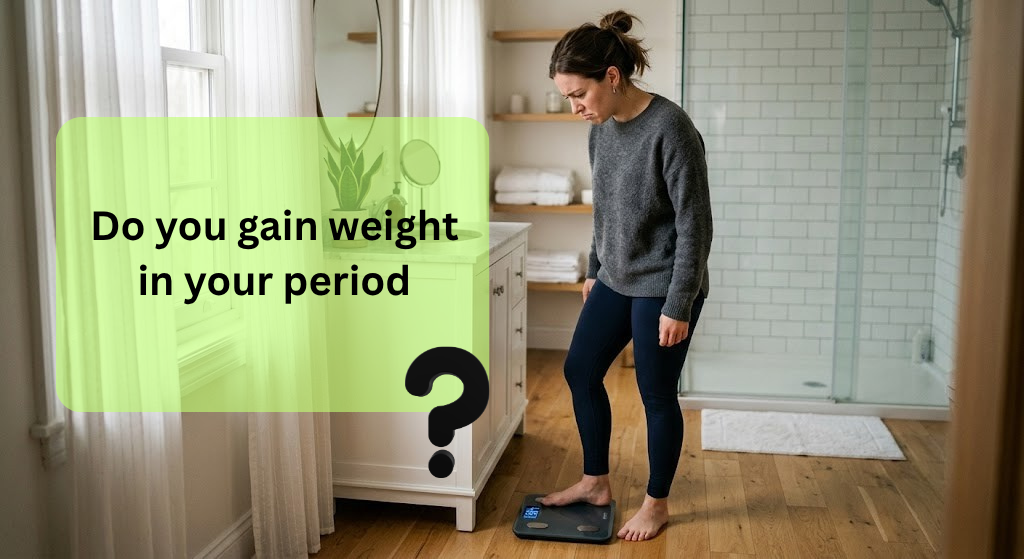
Why You Gain Weight in Your Period (and Why It’s Not Fat)
If you step on the scale a day or two before your period starts and it reads higher, that is not a sign you slipped up. Most people gain weight in your period from fluid, not from body fat, and the shift typically reverses within a few days of bleeding beginning. Put simply, it is a normal monthly pattern, not a personal failure.
That two to five pounds people notice is almost entirely water. Hormones tell your body to hold onto sodium and water in the week before your period, and digestion also slows down a little, so the scale naturally sits higher for a few days. It is a normal part of a monthly cycle, and nearly everyone sees it at least once a month.
Understanding why you gain weight in your period matters more than the number itself. When you know the jump is expected and temporary, you are far less likely to overreact, skip meals, or spiral about progress that never actually disappeared.
My Own Scale Kept Confusing Me
I used to weigh myself every morning like it was a religion. Then one week a month the number would jump up for no reason, and I would panic and cut my breakfast in half.
It took me way too long to connect the dots. That “random” jump happened at the exact same point in my cycle every single time. Once I started tracking my period alongside my weight, the pattern was obvious. My body was not getting fatter overnight. It was holding water.
If this sounds familiar, you are not broken and you are not doing anything wrong. It really is as straightforward as this: your body briefly chooses to gain weight in your period, and then it lets that same weight go.
Why Your Body Holds Onto Water
Right after ovulation, progesterone rises, and it stays elevated until your period starts. This hormone slows down digestion a bit and tells your kidneys to hang onto more sodium and water than usual, according to Cleveland Clinic. That is why so many people say they gain weight in your period no matter how consistently they eat from week to week.
Key takeaway: The number on the scale during your period is mostly water and slower digestion, not new body fat, and it typically resolves on its own within one to three days after your period starts.
Salty food makes this worse. Chips, delivery pizza, canned soup, all of it pulls in extra water and makes the bloating feel heavier than it actually is. Mayo Clinic points out that cutting back on salt in the days before your period can genuinely reduce that puffy feeling.
Fluid retention is also why your rings feel tighter and your ankles look puffier that week. It is the same mechanism that raises the scale, and it follows the same pattern: it builds through the luteal phase, peaks right around day one, then drops off quickly once your period is flowing normally again. In short, how much you gain weight in your period comes down to how much fluid your body happens to hold that given week.

Cravings Are Not Just In Your Head
That urge to eat an entire bag of chocolate two days before your period is real, and it has a hormonal reason behind it. Falling estrogen and progesterone levels affect serotonin, which is part of why you crave sugar, carbs, and salty snacks harder than usual. Those cravings directly add to the weekly gain that makes it feel like you gain weight in your period suddenly.
I used to feel guilty about this, like I had zero self control that week. Turns out my brain chemistry was just working against me a little. Knowing that took the guilt out of it, even on the days I still gave in and ate the chocolate anyway.
You do not need to win a battle of willpower against your own hormones. A handful of dark chocolate or a salty snack now and then is not going to cancel your progress, and giving yourself permission usually makes the craving feel far less urgent than trying to fight it does. Most of the urge to eat more in that window simply reflects what it feels like to gain weight in your period, and treating it as normal takes the panic out of it.
Why Salt and Sugar Make the Gain Weight in Your Period Worse
Both salt and refined sugar feed the two things that drive the bump: water retention and cravings. Understanding how they work together explains why some months feel worse than others, even on the exact same cycle day.
Salt pulls water into your tissues. When estrogen and progesterone are already encouraging fluid retention, a salty meal simply adds more water on top, which is why bloating often spikes the day after takeout or chips.
Sugar, meanwhile, causes quick rises and falls in blood sugar that make cravings louder. If you want to soften the month’s weight bump, the easiest win is cutting salt for the three days before your period and choosing lower sugar snacks when cravings hit.
How to Track Your Cycle Weight Without Obsessing
Tracking is helpful, but only if it does not turn into daily anxiety. A few simple rules keep the habit useful without letting the scale run your morning.
Weigh yourself at the same time each day, ideally right after waking and using the bathroom. Consistency matters more than any single reading, because it removes most of the noise that makes daily numbers feel random, and it is the only reliable way to confirm that you genuinely do gain weight in your period each month.
Look at the weekly average instead of the daily number. One day being up two pounds means nothing on its own, but a rolling seven day average smooths all of that out and shows you the real trend underneath, including the normal gain weight in your period that briefly spikes.
And log your cycle day every time you record weight, not just the number. Without the cycle day attached, you lose the very pattern you are trying to find. The single best predictor of how much you gain weight in your period each month is where you are in your cycle, so that day is the one detail worth getting right.
How Much Weight Is Normal
Most people notice somewhere between two and five pounds of extra weight around their period. Research tracking women through a full cycle found the average bump was closer to about one pound, and it came almost entirely from extra fluid, not fat. Either way, that is a small swing that should never panic you, because it simply represents the normal gain many describe as gaining weight in your period.
A change of more than five pounds, or weight that does not come back down within a week after your period ends, is worth mentioning to your doctor. That is outside the usual pattern.
Because everyone’s baseline is different, the number that matters is your own. If you weigh yourself at the same time each day and log the result, you can build a personal range and stop comparing yourself to averages that may not fit you. Some people notice they gain weight in your period more on high stress months, and that is another useful data point worth writing down.
One useful trick is to weigh in during the first few days of your cycle, when fluid is lowest, and treat that number as your true baseline. Everything you see later in the month becomes easier to understand once you know where you actually start.
Pair your daily log with a period calculator so you always know which phase you are in, and the pattern behind the numbers becomes obvious within two or three cycles.
The Difference Between Period Bloat and Real Weight Gain
It can be hard to tell water weight apart from actual fat gain when they both show up as a higher number on the scale. The difference shows up in timing and in the details more than in any single weigh-in.
Water weight arrives fast, matches your cycle pattern, and leaves on its own. Real weight gain is slower, sticks around after your period ends, and keeps climbing if your habits stay the same month after month. Learning to tell these apart means you stop asking whether you truly gain weight in your period at all.
Bloating, puffiness, and tighter clothing that resolve within a few days point to fluid. A steady upward trend measured over weeks and months, in any part of your cycle, points to something worth looking at more closely. When you understand the order of events, it is much easier to say why you gain weight in your period one week and not the next.
When It Might Not Just Be Your Period
Sometimes what feels like period bloat is something else layered on top. Stress, low sleep, thyroid changes, or conditions like PCOS can all cause weight shifts that get mistaken for a “bad period week.” That explains why tracking matters: it shows whether the number only rises during your window, or whether the gain weight in your period is not really linked to your cycle at all.
If your bloating is severe, painful, or lasts far longer than usual, that is a sign to check in with a healthcare provider rather than blaming your cycle by default.
This is also the reason keeping a few months of numbers helps. When you can see that the weight actually does return to baseline most months, it is far easier to tell a normal cycle bump from a longer-term change that deserves attention.
How Long Does Period Weight Last
For most people, the extra weight starts to fall off once the period actually begins. Day one and day two are usually the heaviest, and the number typically returns to normal between day three and day five of the cycle. In other words, the visible weight gain can start disappearing almost as quickly as it appeared, which is another clue that the gain weight in your period is temporary water.
If you still weigh more a full week after your period ends, it is worth a closer look. That is longer than the usual water weight timeline, and it may mean something other than hormones is driving the change, which makes confirming whether you really do gain weight in your period every month even more important.

What Actually Helps
None of these fix the hormone shift itself, since that is just biology, but they take the edge off the discomfort and make the weeks you gain weight in your period a little easier to get through.
- Cut back on salt for the few days before your period, since sodium pulls in extra water.
- Keep moving, even a short walk, since light activity helps reduce bloating and lifts your mood.
- Add magnesium rich foods like spinach, pumpkin seeds, or dark chocolate, since low magnesium is linked to worse PMS bloating.
- Drink more water, not less, since staying hydrated actually helps your body release retained fluid instead of holding onto it.
- Skip the daily weigh in during this week if the number messes with your head. One week of your cycle is a bad time to judge your progress.
You do not need to do all of these at once. Pick the two that fit your life, and if your period is coming late on top of the bloating, keep in mind that timing shifts can make the whole month feel heavier than usual to track. Either way, expecting to gain weight in your period is not defeatist, it is simply accurate planning.
Adding a little potassium can help too, since it helps balance the sodium that causes fluid to build up. Bananas, sweet potatoes, and leafy greens are easy options, and they fit naturally into the meals you already eat. While potassium helps, do not expect it to erase the gain weight in your period completely, since hormones are still the main driver.
A Quick Week-by-Week View of Weight During Your Cycle
Seeing the pattern on a timeline makes it far easier to predict and to stop second guessing yourself. Here is roughly what happens to the scale at each point in the cycle, assuming you weigh in at the same time of day each time, and it neatly confirms when you will notice the largest gain weight in your period.
- Week one (period days): Fluid drops and the scale trends back down to your baseline.
- Week two (follicular): Usually the lightest, most stable week for weight.
- Ovulation week: A small rise is common as estrogen shifts.
- Week four (luteal): Water retention and cravings peak, and the scale sits highest here.
Once you notice that the same few pounds come and go in the same weeks every month, it stops feeling like a mystery. It is your cycle doing exactly what cycles do, and it is proof that even if you seem to gain weight in your period, you finally understand why.
Cycle Weight Tracker (Embed This Widget)
Since this topic is all about tracking patterns over a cycle, here is a simple embeddable tool readers can use right on the page. It logs cycle day and daily weight, then shows a quick note on where they are in the pattern. Paste this into a WordPress Custom HTML block.
html
Cycle Weight Tracker
Widget concept summary: A lightweight cycle day and weight logger that gives an instant phase reading. It keeps readers on the page longer than a static paragraph would, since they can plug in their own numbers instead of just reading about averages.
Common Mistakes to Avoid When Tracking Weight
Even with good intentions, a few habits quietly sabotage the whole point of tracking. Most of them come from reacting to single weigh ins instead of the overall pattern of how you gain weight in your period month after month.
- Weighing at random times: A day's reading swings several pounds depending on food, fluid, and when you last ate. Pick one fixed time and stick to it.
- Trusting one big jump: A single higher morning often gets treated like real progress lost, when it is usually just another wave of water.
- Ignoring the cycle day: Record the day every single time, or the numbers become impossible to interpret once your period arrives.
- Weighing mid luteal: That is the least useful time to judge anything, because it is the exact window you gain weight in your period.
If you can avoid these four, your logs will actually tell you something useful. The goal is not a perfectly flat line, it is a line you can finally explain, because the clearest path to peace is knowing precisely when you tend to gain weight in your period.
FAQs
Do you gain weight the day your period starts? Yes, day one often feels like the heaviest point since fluid retention peaks right before bleeding starts, then it eases up over the next few days. That timing is exactly why it feels like you gain weight in your period overnight, even though it built up slowly.
Is period weight gain fat or water? It is almost always water and slower digestion, not fat, and it resolves on its own within a few days after your period starts. In practice, nearly all of the gain weight in your period is temporary, so it should not change any decisions about food or training.
How many pounds do you gain on your period? Most people gain between two and five pounds, though some notice less and some notice more depending on diet and hormone sensitivity. Whatever you personally observe, you can safely assume you will still gain weight in your period a little every single month until your cycle changes.
Does period weight go away on its own? Yes, for most people it clears up within one to three days after their period starts, without needing to do anything special. That is the single most reassuring fact about the whole topic: the gain weight in your period is designed to leave on schedule.
Why did I gain 5 pounds on my period? A five pound jump is at the high end but still within the common range for water retention, especially if you also ate more salty food or carbs that week. If it keeps happening or does not resolve, check in with your doctor.
Does every person gain weight in the period week? Not everyone does, but most people see at least a small bump. Sensitivity to progesterone and estrogen varies a lot from person to person, so the exact number is personal, not universal.
Conclusion
Do you gain weight in your period? For almost everyone, yes, and the honest answer is that it is water, hormones, and slower digestion working together for a few days, not your body suddenly gaining fat. Track it, expect it, and skip the scale that week if the number messes with your head.
CTA: If you track your cycle already, log your weight on the same cycle day for a few months using the tracker above and see your own pattern instead of guessing.
The scale is only one tiny piece of the picture, and for one week a month it lies to you on purpose. The question is not really whether you gain weight in your period, but whether you let a temporary water weight bump convince you that your progress is gone.
This article is for general informational purposes and is not a substitute for professional medical advice. Talk to your doctor if your weight changes by more than five pounds during your cycle or does not return to normal within a week after your period ends.