
If your periods have slowly been getting longer, you are probably asking why your cycle change from 28 to 31 days happened, and whether it is normal. It usually is, and this guide explains the reasons in plain language, what to track, and the exact situations where a longer cycle deserves a doctor visit.
A cycle change from 28 to 31 days still sits inside the healthy 21 to 35 day range, so the movement itself is rarely a problem. The real question is what nudged your hormones, and this article walks through each of the usual suspects, from stress to thyroid changes to the quiet approach of perimenopause.
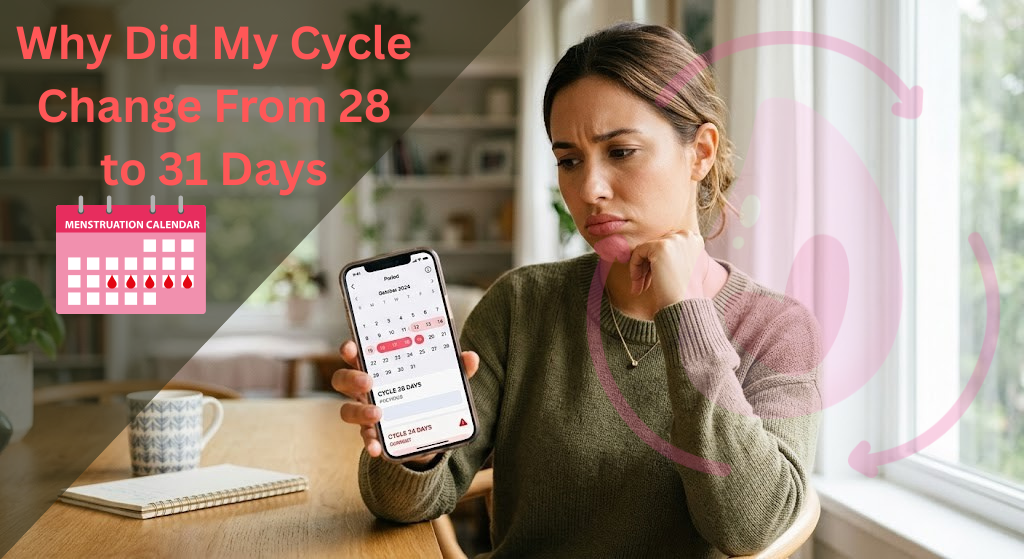
Why did my cycle change from 28 to 31 days is the exact phrase I typed into Google at 11pm, calendar app open on one side of my screen and three months of period tracking data on the other. For years my cycle ran like a train schedule. Day 28, no surprises, no drama. Then it started stretching to 30 days, then 31, and I spent a full week convinced something was wrong with me.
Turns out I’m nowhere near alone here. A cycle change from 28 to 31 days is one of the most searched period questions out there. A few extra days on your cycle is one of the most searched period questions out there, and most of the time the answer is way less scary than what your brain cooks up at midnight.
Is a 31 Day Cycle Still Normal
A cycle length between 21 and 35 days is considered medically normal, so going from 28 to 31 days still falls inside that healthy range. Nothing is broken. Your body just moved a few days over on the calendar, and the average cycle length across most people actually lands closer to 29 days anyway.
Here’s something nobody mentions in health class either. The textbook average is not a personal promise, which is why a cycle change from 28 to 31 days can feel huge even though it is small. A 28 day cycle isn’t the rule. It is only one number among many, and it makes the occasional cycle change from 28 to 31 days look far scarier than it is. It’s just the number that made it into textbooks because it’s tidy and easy to explain.
That said, normal doesn’t mean ignore it completely. If you can find the trigger for your cycle change from 28 to 31 days, you can usually let it go. If your cycle used to be rock solid and then it shifted, your body is usually reacting to something. The trick is figuring out what.
The Real Reasons Your Cycle Shifted
Your menstrual cycle runs on a chain of hormones between your brain and your ovaries, mainly estrogen and progesterone. That chain is touchy. It reacts to sleep, stress, food, exercise, illness, medications, even age. A 3 day shift is usually your body’s way of flagging that something in that chain got nudged. That nudge is the story behind almost every cycle change from 28 to 31 days.
Here are the usual suspects, one at a time. Each one explains a specific cycle change from 28 to 31 days without any alarm bells.
Stress and Sleep Changes
This is the one I see most often, and honestly, the one that got me. My own cycle change from 28 to 31 days traced straight back to a stressful job switch. I’d switched jobs right before my cycle started drifting, and I didn’t connect the dots until my doctor asked about it point blank.
Stress raises cortisol, and cortisol competes with the same hormonal pathway that controls ovulation. When cortisol stays elevated for weeks, ovulation can get pushed back a few days, which drags your whole cycle later with it.
Bad sleep does something similar. A few rough weeks of sleep can trigger a cycle change from 28 to 31 days all on its own. Your body leans on consistent sleep cycles to help regulate hormone timing overnight. A few weeks of rough sleep, whether from a new baby, a brutal work deadline, or just scrolling your phone too late, can be enough to throw things off.
Key takeaway: A late period doesn’t automatically mean something is wrong. It often just means your last few weeks were harder on your body than usual.
Quick check: think back over the last 6 to 8 weeks. New job? Breakup? Travel? Sleep schedule wrecked? If any of that sounds familiar, you probably just found your answer.
Weight Changes and Exercise
Any noticeable weight change, up or down, can mess with cycle length. Fat tissue actually plays a role in producing estrogen, so losing or gaining weight quickly can scramble the signal your brain sends to your ovaries.
Exercise works the same way. Ramped up training often coincides with a cycle change from 28 to 31 days in active people. Started training for a half marathon lately, or ramped up your workouts more than usual? That extra physical stress can delay ovulation just like emotional stress does.
None of this means you need to quit exercising. It just means your body might need a little runway to adjust before your cycle finds its rhythm again.

Birth Control and Hormonal Shifts
If you recently started, stopped, or switched birth control, that’s almost always your answer. Hormonal birth control runs your cycle on autopilot, so once you come off it, your natural hormones need a few months to figure out their own rhythm again.
Even switching pill brands, or moving from a hormonal IUD to a copper one, can cause a temporary shift in cycle length. Give that kind of cycle change from 28 to 31 days two or three months before judging it. Certain other medications, including some antidepressants, have also been linked to cycle changes. Give it 2 to 3 cycles before you start worrying.
Thyroid and PCOS
Your thyroid has more influence over your period than most people give it credit for. Both an underactive and an overactive thyroid can change how often you ovulate, which changes cycle length. If you’re also dealing with fatigue, hair thinning, or unexplained weight changes on top of the cycle shift, it’s worth asking your doctor for a basic thyroid panel.
PCOS, or polycystic ovary syndrome, is another common culprit, especially if your cycles have been gradually getting longer and less predictable rather than just nudging up by a few days. According to the Mayo Clinic, irregular or absent periods are one of the core symptoms of PCOS, often paired with acne or extra hair growth.
A jump from 28 to 31 days on its own usually isn’t enough to point to PCOS. Think of it more as a flag to watch for if other symptoms start piling on. If this sounds familiar, our guide to common menstrual symptoms walks through what else to look for.
Getting Closer to Perimenopause
If you’re in your late 30s or 40s, a gradual lengthening of your cycle can simply mean your body is starting the slow walk toward perimenopause, which can actually begin over a decade before menopause itself hits.
During this stage, ovulation gets less consistent, which stretches cycle length out little by little. Inconsistency is the signature of the age related cycle change from 28 to 31 days. It’s not a switch that flips overnight. It’s more like a dimmer slowly turning down.
If this is what’s going on, you’ll usually notice a few other small changes too, like a different flow, sharper PMS, or the occasional skipped period over time. Our guide to signs your period is coming late breaks down what to watch for next.
When a Few Extra Days Is Nothing to Worry About
Here’s the honest, unglamorous truth. A one time cycle change from 28 to 31 days with no other symptoms is usually just noise. A single shift from 28 to 31 days, especially a one time thing on an otherwise regular cycle, is usually just noise. Bodies aren’t machines. Even with no obvious trigger, cycle length can naturally drift by a few days from month to month.
If your period still shows up, your flow feels normal, and you’re not dealing with new symptoms, there’s a good chance this smooths itself out within a cycle or two. Most people who notice a cycle change from 28 to 31 days watch it resolve within two cycles. If your period is simply late and there’s any chance of pregnancy, a quick home pregnancy test can rule that out before you assume it’s stress or lifestyle related.
When You Should Actually Call Your Doctor
You don’t need to panic over a 3 day shift, but a few situations are worth getting checked out for real:
- Your cycle keeps getting longer month after month
- You go more than 42 days without a period
- Your cycle length swings wildly from month to month
- You have new symptoms like severe cramps, very heavy bleeding, or unusual discharge
- You’re trying to get pregnant and want a clearer read on your fertile window
- You’re noticing fatigue, hair loss, or unexplained weight changes
The American College of Obstetricians and Gynecologists notes that any significant or ongoing change in cycle pattern is worth discussing with a doctor, since it can sometimes point to an underlying hormonal issue that’s easy to manage once it’s caught.
How to Track Your Cycle So You Stop Guessing
The fastest way to tell if your 31 day cycle is a one time blip or a new pattern is to actually track it instead of trying to remember it. Tracking is the only way to see whether a cycle change from 28 to 31 days is a trend or a blip. A simple period tracking app does this for you automatically and can show you trends over 3 to 6 months. Research from Clue backs this up, noting that even small shifts in ovulation timing are common and easier to spot with consistent tracking than with memory alone.
Here’s what I’d personally log each cycle: This is the exact log that caught my own cycle change from 28 to 31 days before I worried about it.
| What to Log | Why It Matters |
|---|---|
| Start date of period | Shows exact cycle length |
| Flow intensity | Flags unusual heavy or light months |
| Sleep quality | Connects lifestyle to cycle shifts |
| Stress level | Helps spot stress related delays |
| Any new medications | Rules out medication side effects |
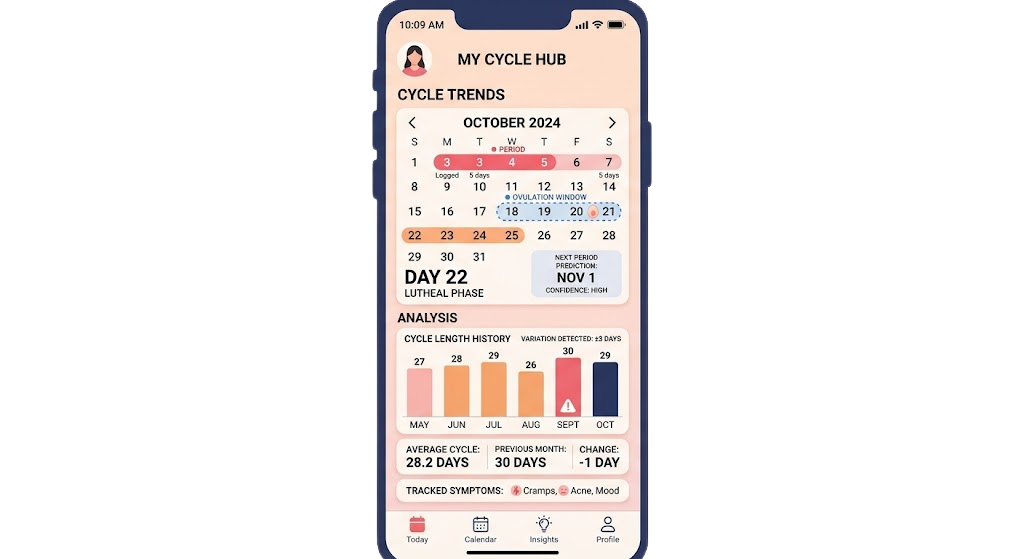
If you want to go deeper on building a real cycle tracking routine, plug your last few cycle lengths into the free period calculator for an instant breakdown of your own average.
How Long Does It Take for a Cycle to Settle After a Change
Once the trigger fades, most cycles drift back to their old average within a cycle or two. If a stressful project ends, you catch up on sleep, or your workout load evens out, you will often see the cycle change from 28 to 31 days reverse on its own by the next month or the month after. Hormones are slower than moods, so allow at least two full cycles before you judge whether the new length is here to stay.
If you recently changed birth control, expect an even longer runway. Coming off the pill or switching methods can produce an irregular cycle change from 28 to 31 days, or wider, for two to three months while your natural rhythm reasserts itself. Mark those dates down, keep logging, and resist the urge to test your patience daily.
There is also a season of life where the lengthening is the new normal. Around perimenopause, cycles get longer in a gradual, bumpy way, sometimes 30 days, sometimes 36, then back to 29. If you are in your late 30s or 40s and seeing that wandering pattern, it is less a problem to fix and more a trend to observe with your doctor.
A Month by Month View of Your Own Numbers
The most calming exercise after noticing a cycle change from 28 to 31 days is to write out your last six start dates and count each gap. Seeing six months of dates on paper is how a cycle change from 28 to 31 days stops feeling scary. You will often spot that one month was 28, the next 30, then 31, then back to 29, which looks like chaos until you average it. That average is what matters, and it is almost always well inside the normal band.
Seeing the full picture also separates a real trend from a one off. A steady march upward, 28, 29, 30, 31, tells a different story than one stretched month surrounded by ordinary ones. If the march continues for three or four cycles, that is a meaningful signal worth discussing; if it dips back, your body was simply having a month.
Keep the tracking simple so you actually stick with it. Simplicity is what turns a cycle change from 28 to 31 days into useful, boring data. The start date of each period is the single most important number, because everything else can be reconstructed from it. Add a one line note for stress, sleep, or travel, and in three months you will have enough data to stop guessing entirely.
FAQs
Is it normal for your cycle to change from 28 to 31 days?
Yes. Cycle lengths between 21 and 35 days are considered medically normal, so a shift within that range usually isn’t a red flag on its own.
Can stress alone add days to your cycle?
Yes. Stress raises cortisol, which can delay ovulation and push your period back a few days.
Does a 31 day cycle mean I’m not ovulating?
No. You can still ovulate normally on a 31 day cycle. Ovulation typically lands around day 17 instead of day 14.
Should I worry if this only happened once?
No. A single shift is common and usually resolves on its own within a cycle or two.
Can diet changes affect cycle length?
Yes. Sudden changes in calorie intake or fast weight loss can affect hormone production enough to shift your cycle by a few days.
Can a cycle change from 28 to 31 days affect my fertile window? Yes, a longer cycle usually means you ovulate later, often around day 17 instead of day 14. Your fertile window moves with that timing, so if you are trying to conceive or avoid pregnancy, do not rely on a fixed day 14 assumption.
Is a cycle change from 28 to 31 days more common with age? Very common. Cycle length tends to drift naturally as you age, often lengthening through your 30s and early 40s before perimenopause adds irregularity. It is one of the most predictable cycle changes that exists.
Final Thoughts
A cycle moving from 28 to 31 days feels alarming when you’re used to being predictable, but for most people it’s just your body reacting to something in daily life, whether that’s stress, a sleep change, a new workout routine, or simply age catching up with your hormones. Give your body a cycle or two to settle, keep tracking what’s happening, and only bump it up to a doctor visit if the pattern keeps shifting or new symptoms tag along with it.
The single best habit is to stop comparing this month to your old textbook average and start comparing it to your own last three months. A cycle change from 28 to 31 days is only meaningful in the context of your own data, and once you see it as a small, common drift rather than a medical mystery, most of the worry drains out of it. Track, wait, and let one or two normal months do the convincing.
CTA: If your cycle keeps changing month after month, don’t just guess. Start logging today so a cycle change from 28 to 31 days becomes something you understand instead of fear. Start tracking today so you walk into your next doctor visit with real data instead of a vague feeling that something’s off.
Pingback: Why Does My Uterus Hurt? Signs, Causes, and Real Relief