
A period calculator is a simple tool that helps you track your menstrual cycle, predict your next period, and estimate ovulation. Understanding your menstrual cycle can feel confusing at first. Many people wonder why their period dates change, why it is late, or when ovulation happens. This is where a period calculator becomes especially helpful.
A period calculator uses the first day of the most recent menstrual period and the average cycle length to estimate the next period, the ovulation day, and the fertile window.
Tracking the menstrual cycle offers several advantages. It enables planning activities, preparing for symptoms, monitoring hormonal patterns, and supporting both pregnancy planning and prevention. Individuals who menstruate may benefit from using a period calculator.
Let’s review the process step by step.
What Is a Period Calculator and How Does It Work?
A period calculator, whether digital or manual, estimates when your next period will start by analyzing your previous cycle dates and average cycle length.
Cycle prediction relies on hormonal patterns. Most menstrual cycles follow a rhythm regulated by estrogen and progesterone. While individual cycles vary, many are predictable.
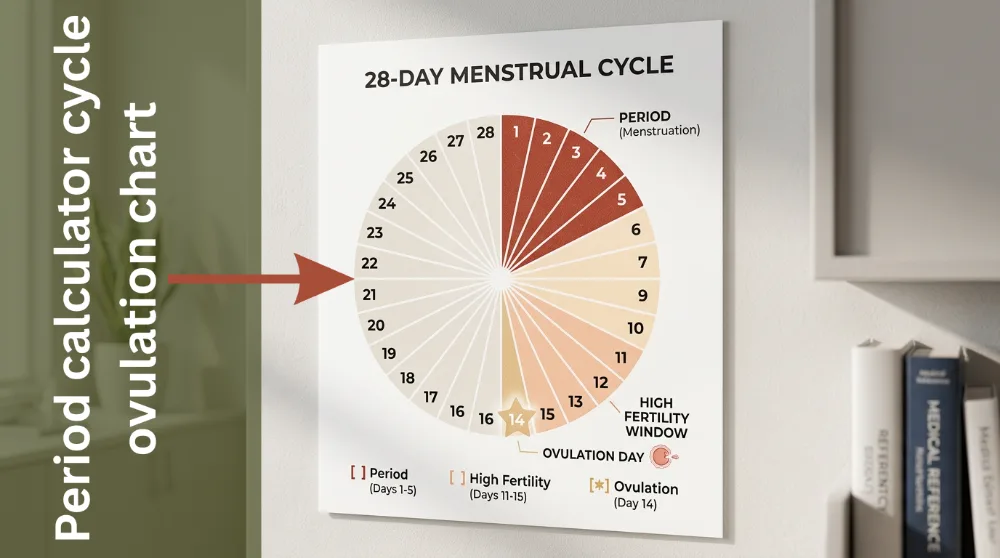
The average menstrual cycle is 28 days, though adult cycles typically range from 21 to 35 days. Cycles in teenagers may vary more widely.
A period calculator uses:
- The first day of your last period
- Your average cycle length
Using this information, the calculator estimates your next period and ovulation date.
It applies a mathematical approach, making it more reliable than relying solely on memory.
Here’s a simple example to make it clearer:
| Last Period Start | Cycle Length | Predicted Next Period |
| March 1 | 28 days | March 29 |
| April 10 | 30 days | May 10 |
| June 5 | 26 days | July 1 |
A period calculator measures the time between cycles to create a prediction model. The more regular your cycle, the more accurate the predictions.
Using a Period Calculator Between Two Dates
Many tools allow you to enter two past period dates. This improves prediction accuracy. If your cycles are consistent, entering multiple past dates helps the calculator find your average cycle length. This method works best for people with regular cycles. If your cycle varies each month, you may need to track longer to see patterns.
Consistency is the key. Missing entries reduce accuracy.
How a Period Calculator Works
A Period Calculator uses:
- The first day of your last period
- Your average cycle length
Once entered, it predicts:
- Your next period date
- Your ovulation day
- Your fertile window
Example Calculation
| Last Period | Cycle Length | Predicted Next Period |
| July 1 | 28 days | July 29 |
| August 10 | 30 days | September 9 |
This process is often called a period calculator between two dates, because it measures the number of days between cycles and builds a pattern.
The more months you track, the better the predictions become.
How to Calculate Next Period Date Manually
- If you want to calculate it yourself:
- Identify the first day of your last period.
- Add your average cycle length.
- The result is your expected next period date.
For example, if your cycle is 30 days and your period started September 3, your next one should begin around October 3.
Manual tracking works for regular cycles, but digital tools reduce errors and adjust automatically when cycles shift. For example, if your cycle suddenly becomes 26 days after months of 30-day cycles, a calculator recalculates instantly, while a paper calendar leaves you guessing.
Period Tracker vs Period Calculator
Many women wonder whether they need a period tracker or just a calculator. The answer depends on your goal.
| Feature | Period Calculator | Period Tracker |
| Predicts next period | Yes | Yes |
| Calculates ovulation | Yes | Yes |
| Tracks symptoms | Limited | Detailed |
| Long-term data analysis | Basic | Advanced |
If you want simple predictions, a calculator is enough. If you want deeper health insights like mood patterns, cramps, headaches, or flow intensity, a tracker is more useful. Start with a calculator, and add a tracker only if you find yourself wanting more detail.
Most modern apps combine both tools.
Pregnancy Week Calculator by Due Date
Ovulation tracking connects directly to pregnancy timing. If you know your ovulation date, you can estimate your conception date. Doctors often calculate pregnancy weeks from the first day of your last period.
A pregnancy week calculator by due date works backward from your expected delivery date. Conception usually happens within 24 hours of ovulation. However, sperm can live inside the body for up to five days. Understanding ovulation makes pregnancy calculations clearer and more accurate.
Clearing Up Confusion: What Does “How to Calculate Payback Period” Actually Mean?
Sometimes, people searching for a period calculator see the phrase “how to calculate payback period” and get confused. The two topics are completely different. The payback period is a financial term that measures how long it takes an investment to recover its cost. It has nothing to do with menstrual cycles or reproductive health.
Search engines sometimes group the phrases together because the word “period” appears in both. If you came here for the financial meaning, you’re in the wrong place, but if you’re here to understand your cycle, you’ve come to exactly the right page.
Tips for Getting Accurate Predictions
Accuracy comes from data quality, not fancy features. Start by logging the exact first day of each period, the day real bleeding begins, not spotting. Then update your average cycle length after every cycle so the tool recalculates your pattern. Most people reach reliable predictions after three to six cycles of consistent logging.
Use one calendar or one period calculator consistently rather than switching between apps. Different tools count days slightly differently, which can confuse your records. If you travel across time zones, keep your logs in your home time zone to avoid shifting the dates.
Combine your calculator with symptom notes. Ovulation signs like cervical mucus changes, mild cramps, or a slight temperature rise help you confirm whether your predictions line up with reality. Over time, this feedback loop makes your estimates noticeably sharper.
When to Consult a Doctor About Your Cycle
A period calculator is a planning tool, not a diagnostic one. You should talk to a healthcare provider if your cycles are consistently shorter than 21 days or longer than 35, if you skip several periods without being pregnant, or if bleeding is heavy enough to interrupt your day. The American College of Obstetricians and Gynecologists (ACOG) offers helpful guidance on what counts as a normal menstrual cycle.
Persistent pain is another reason to seek care. Conditions like PCOS, thyroid problems, and fibroids often show up in cycle changes long before other symptoms appear. If you feel sharp or unusual pelvic discomfort, our article on why your uterus hurts lists the common causes and when they deserve a professional opinion.
Common Mistakes People Make When Using a Period Calculator
Many prediction errors result from small mistakes.
One common mistake is using the wrong cycle length. Some people count from the last day of bleeding instead of the first.
Another mistake is ignoring symptoms. Ovulation signs help improve prediction accuracy.
Tracking inconsistently also reduces reliability. Skipping months creates gaps in data.
Always count from Day 1 of bleeding, not spotting.
Why Menstrual Cycle Tracking Matters
Tracking your menstrual cycle is one of the simplest ways to understand your reproductive health. When you use a period calculator or a period tracker, you get a clearer picture of when your next period may arrive, when you might ovulate, and how your cycle behaves over time.
A cycle is not just a monthly event. It reflects hormonal patterns that influence mood, energy, appetite, sleep, and fertility. When you track consistently, you start seeing patterns that help you prepare for symptoms like cramps, headaches, bloating, or mood changes. For more detail on the symptoms people experience, see our overview of common menstrual symptoms.
For people trying to conceive, tracking helps identify when you are ovulating, or the probable days when you’re most fertile. If you are avoiding pregnancy, cycle awareness helps you manage timing and reduce risk.
Digital tools like a period calculator between two dates or a menses calculator make the process easier. They quickly estimate your next period by analyzing your previous cycles. Most calculators only need two pieces of information: the first day of your last period and the average length of your cycle. You can also use a global period calculator when you need extra flexibility.
Another benefit is clarity when your period seems late. Many people worry, “Is my period late?” Our guide to signs your period is coming late explains the difference between a normal delay and something worth checking with a doctor.
Overall, tracking your cycle gives you control over your health, improves planning, and supports a better understanding of your fertility.
Factors That Can Change Your Period Dates
Your menstrual cycle is influenced by more than just hormones. Several external and internal factors can change your period dates, even if you usually have regular cycles. Understanding these factors helps improve the accuracy of any Period Calculator, whether manual or digital.
1. Stress
High stress levels affect hormones like cortisol, which can delay ovulation. When ovulation shifts, your period arrives earlier or later than expected. Even good stress—like exams, new jobs, or major events—can influence your cycle.
2. Diet and nutrition changes
Sudden weight loss or gain, strict diets, or nutrient deficiencies may cause irregular cycles. The body requires balanced nutrition for hormonal stability.
3. Sleep and lifestyle
Poor sleep, night-shift work, or inconsistent routines impact hormone production. The more inconsistent your lifestyle, the more likely your cycle might shift.
4. Exercise intensity
Extremely heavy workouts or rapid increases in training intensity can lead to delayed or skipped periods, especially for athletes.
5. Birth control or medication
Contraceptives, hormonal treatments, and some medicines can change the timing and length of your period.
6. Medical conditions
Conditions like PCOS, thyroid disorders, or hormonal imbalances can significantly affect menstrual timing. In these cases, using a menstrual calculator for irregular periods can help track patterns but may not provide perfect predictions.
By understanding these factors, you can use your period calculator more effectively and spot unusual changes sooner.
Irregular Cycles: What They Mean
Not everyone has a 28-day cycle. Many people experience irregular cycles at some point in their lives. An irregular cycle means your period does not follow a predictable pattern. It may come early one month and late the next. Cycle length may change frequently, or bleeding may be lighter or heavier than usual.
There are several reasons for irregular cycles:
Hormonal imbalance
Fluctuations in estrogen or progesterone can cause shorter or longer cycles. Teenagers and perimenopausal women often experience this naturally.
Ovulation irregularity
If ovulation does not occur at the same point each month, the cycle becomes uneven. Tracking helps you estimate when you ovulate, but unpredictable ovulation makes prediction more challenging.
Medical conditions
PCOS, thyroid issues, uterine fibroids, or endometriosis may cause irregular cycles. A menses calculator for irregular periods helps monitor patterns but cannot diagnose conditions.
Lifestyle causes
Stress, poor sleep, rapid weight changes, or extreme exercise all contribute to irregular timing.
Even if your cycles are irregular, using a period calculator between two dates helps you identify the average cycle length over time. While predictions may not be exact, long-term tracking reveals patterns you may not notice otherwise.
Think of the average as your personal baseline. If your cycle usually runs 33 days and suddenly drops to 24 days for two months in a row, that change is more meaningful than the number itself. Writing those observations down, even briefly, gives your doctor something concrete to work with if you ever need advice.
Irregular cycles are common. What matters is consistency in tracking and paying attention to unusual changes. If irregularity becomes frequent or severe, it’s always a good idea to consult a healthcare professional.
Understanding Your Ovulation Window
Ovulation is the moment your ovary releases an egg, and it is the center of your entire cycle. For most people, it happens about 14 days before the next period starts, not 14 days after the last one ends. That small difference matters more than people expect, because it is why a 26-day cycle and a 34-day cycle ovulate on completely different days of the month.
A period calculator does this work for you. It takes your cycle length, works backward from your predicted next period, and highlights the days when conception is most likely. The fertile window is wider than the day of ovulation itself, usually about six days long, because sperm can survive in the body for several days.
You can confirm the estimate with physical signs. Many people notice clearer cervical mucus, mild pelvic twinges, or a slight rise in basal body temperature around ovulation. When your observations line up with the calculator’s predictions, you can trust the tool more with each passing cycle.
Tracking Across Different Stages of Life
Your cycle does not stay the same forever, and a good period calculator is flexible enough to move with you. Teenage cycles are often longer and less predictable while hormones settle. In the middle of reproductive life, cycles tend to stabilize, which is exactly when predictions are most reliable.
Pregnancy, childbirth, and breastfeeding all change the rhythm of your cycle for months. Many people find their cycle returns to a different length than before, and a fresh set of logged dates helps the calculator relearn the new pattern. Our guide to your first period after giving birth explains what those changes look like.
As you approach perimenopause, cycles can shorten, lengthen, or skip entirely. Tracking through these transitions gives you and your doctor a clear record of what is happening, which is far more useful than trying to remember the last six months from memory. Whatever stage you are in, the habit of logging your dates keeps you in control of your own health.
Frequently Asked Questions:
1. What is a Period Calculator used for?
It estimates your next period using the first day of your last cycle and your average cycle length. It can also predict ovulation, fertile days, and general cycle patterns.
2. How accurate is a Period Calculator?
Accuracy depends on how regular your cycles are. Regular cycles give reliable predictions; irregular ones may vary. Using a period calculator between two dates improves accuracy. If irregularity continues, consult a healthcare provider.
3. Can a Period Calculator tell me when I ovulate?
Yes. Most tools estimate ovulation about 14 days before your next expected period, helping identify fertile days.
4. What’s the difference between a Period Calculator and a period tracker?
A calculator predicts dates, while a tracker records symptoms, moods, and long-term patterns. Many apps combine both.
5. Can I use one if my periods are irregular?
Yes, but predictions may not be exact. A menses calculator for irregular periods helps you find the average cycle length. If the irregularity persists for several months, talk to a doctor.
6. Does it help with pregnancy planning?
Yes. Estimating ovulation and fertile days helps you time intercourse. After conception, you can use a pregnancy week calculator by due date.
7. How do I calculate my next period manually?
Add your average cycle length to the first day of your last period. Digital tools reduce mistakes.
8. Why do I see “how to calculate payback period” online?
Both topics contain the word “period,” even though the financial payback period is unrelated to menstrual health.
9. What if my period is late?
Use a ” is my period late calculator to check your range. Stress, travel, or hormonal shifts may delay it. If it’s over 7 days late, consider a pregnancy test or consult a provider.
10. How many cycles should I track?
Tracking 3–6 cycles gives the best predictions. More data leads to more accurate results.
Conclusion
Tracking your menstrual cycle with a Period Calculator is one of the simplest ways to understand your reproductive health, predict important dates, and stay prepared. Whether you use a digital period tracker, a period calculator between two dates, or a manual method, consistent tracking helps you learn how your body works. You can predict ovulation, identify your fertile window, and understand why your period may come early or late.
Cycle changes can occur due to stress, lifestyle shifts, medical conditions, or natural hormonal fluctuations. That’s why it’s important to track regularly and pay attention to your unique patterns. A Period Calculator gives you a clearer picture of your cycle, but your daily habits and overall health also play an important role.
If your cycles are irregular, confusing, or cause concern, consider consulting a healthcare provider for personalized guidance. For most people, long-term tracking brings clarity, confidence, and better planning, whether for daily life, fertility goals, or overall well-being.
Start small today. Log your last period, open a calculator, and let one month of data be the beginning of a healthier, more informed relationship with your cycle.
Using the right tools, staying consistent, and understanding your body’s signals can help you take control of your menstrual health with ease.