
Author Note: Written by a health content writer who has personally tracked three pregnancies and spent way too many mornings squinting at toilet paper trying to figure out what was going on down there.
What does implantation bleeding look like? It usually shows up as light pink or brown spotting, not a full flow. It’s much lighter than a period, lasts one to three days, and often shows up as a faint smear when you wipe rather than anything that soaks a pad.
Table of Contents
- The Morning I Almost Ignored It
- What Implantation Bleeding Actually Looks Like
- Implantation Bleeding vs. Period: The Real Differences
- How Long Does It Actually Last
- When It Happens After Ovulation
- Other Signs That Showed Up Around the Same Time
- When Spotting Is Probably Not Implantation Bleeding
- Should You Test Yet
- FAQs
- Conclusion
The Morning I Almost Ignored It
I was standing in my bathroom at 6:45 in the morning, running late for work, when I noticed a faint pink smudge on the toilet paper. My period wasn’t due for another five days. My first thought was that my cycle had gone haywire again.
I’d had irregular spotting before, mostly stress-related, so I almost brushed it off. What made me pause was how it looked. It wasn’t red like the start of my period usually is. It was pale, almost dusty pink, and there was barely anything there. I’d been trying to conceive for four months at that point, so instead of shrugging it off, I opened my Free Period Calculator to check exactly where I was in my cycle. Turns out I was 9 days past ovulation, right in the window doctors call implantation bleeding.
That single spotting event lasted about a day and a half. No cramping worth mentioning, no clots, nothing that needed more than a panty liner. Two weeks later, I got my positive test.
What Implantation Bleeding Actually Looks Like
Most women describe it the same way I did: light pink or brownish, more like the tail end of a period than the start of one. According to Cleveland Clinic, implantation bleeding is usually brown, dark brown, or pink, spotty rather than continuous, and shouldn’t soak through a pad.
Key Takeaway: If what you’re seeing looks more like discharge with a tint of color than an actual flow, and it’s not getting heavier day by day, that’s the biggest clue you’re dealing with implantation spotting rather than a period.
The color comes down to how old the blood is by the time it leaves your body. Fresh blood is brighter red. Blood that’s taken a little longer to travel shows up brown or rust colored, which is why so many people describe implantation bleeding as “old blood” rather than a real bleed.
Implantation Bleeding vs. Period: The Real Differences
This is the part I wish someone had explained to me sooner, because color alone isn’t always enough to go on.
- Color: Implantation bleeding tends to be light pink or brown. A period usually starts pinkish or bright red and gets darker red as it goes.
- Flow: Implantation spotting stays light the whole time. A period typically starts light and builds up over the first day or two.
- Clots: Implantation bleeding doesn’t usually come with clots. If you’re seeing clots, WebMD notes that’s more consistent with a regular period.
- Duration: Spotting from implantation is short, often gone within a day or two. A full period runs closer to four to seven days.
- Cramping: Mild or none at all with implantation. Period cramps tend to be stronger and build over the first day.
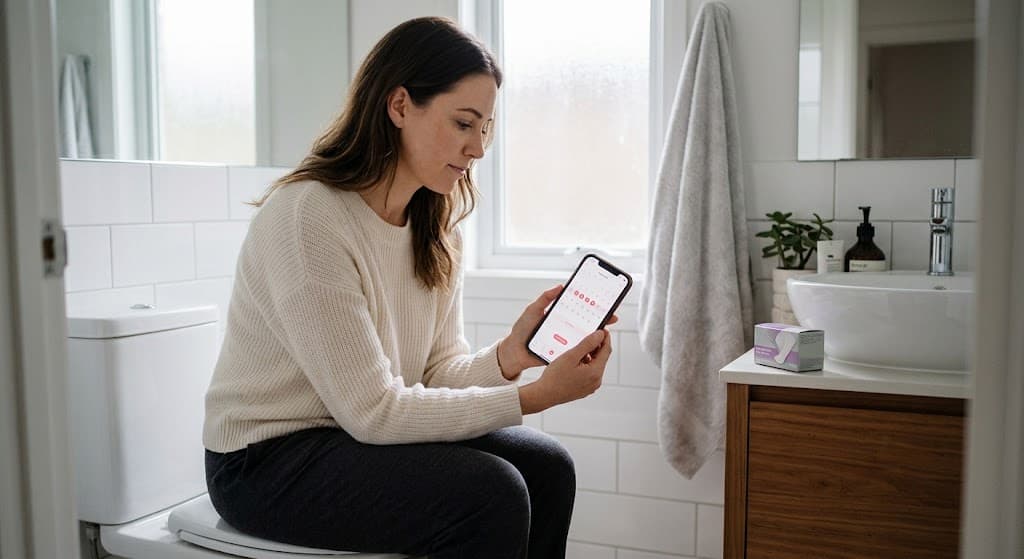
If you’re not sure which category your spotting falls into, cross-checking the date against your actual cycle length matters more than staring at the color. That’s the one thing a calendar guess can’t tell you, but a proper tracker can.
How Long Does It Actually Last
For most people, implantation bleeding wraps up within one to three days. American Pregnancy Association puts the window at a few hours up to three full days, and says anything longer or heavier than that is unlikely to be implantation related.
Mine lasted about 36 hours. A friend of mine who went through IVF said hers was barely a few hours, just a couple of wipes and then nothing. Both of us ended up pregnant. That range is completely normal, which is honestly one of the more frustrating parts of trying to figure this out in the moment.
When It Happens After Ovulation
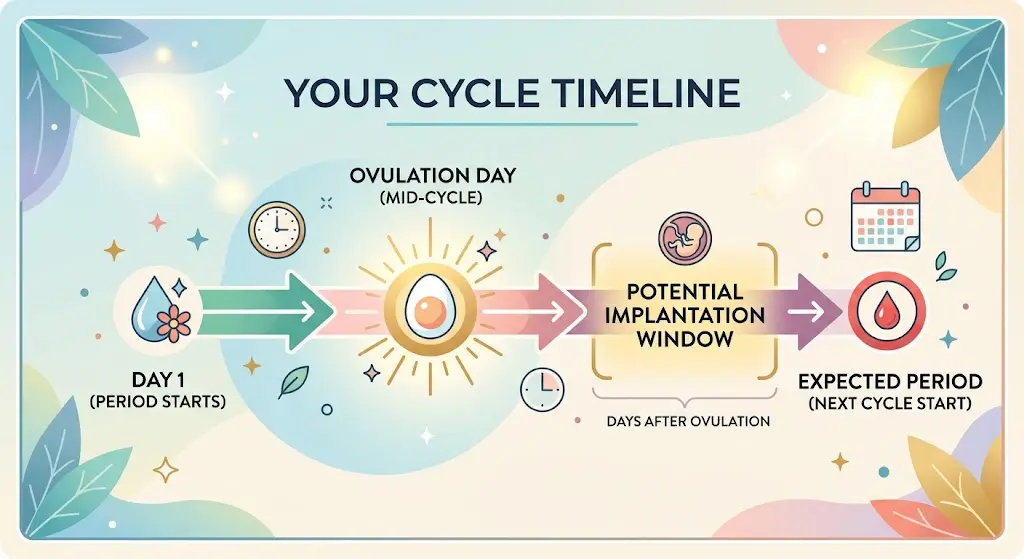
Implantation typically happens 6 to 12 days after ovulation, according to Flo Health, which lines up almost exactly with when a lot of people expect their period. That overlap is exactly why so many people mistake it for an early period in the first place.
This is where actually knowing your ovulation date pays off. If you track your cycle with something like the Free Period Calculator you can see at a glance whether spotting is showing up 6-12 days post-ovulation, which points to implantation, or right on schedule for your period, which points to, well, your period.
Other Signs That Showed Up Around the Same Time
For me, the spotting wasn’t the only strange thing that week. I was more tired than usual by 8pm, my bras felt tighter, and I had a mild headache for two straight days. None of that screamed pregnancy on its own since PMS can mimic almost all of it too.
Symptoms that commonly show up around implantation bleeding include:
- Sore or tender breasts
- Mild cramping, lower and duller than period cramps
- Fatigue that hits earlier in the evening than normal
- Slight bloating
- Mild headaches
None of these confirm anything by themselves. Together with the timing and the light spotting, they’re worth paying attention to.
When Spotting Is Probably Not Implantation Bleeding
I want to be straightforward here because this matters. Not all early spotting is implantation bleeding, and some of it needs a doctor’s attention rather than a wait-and-see approach.
Talk to your doctor if you notice:
- Bright red or heavy bleeding that fills a pad
- Bleeding with clots
- Bleeding that lasts more than three days
- Severe pain, especially on one side
- Dizziness or fainting along with the bleeding
MemorialCare points out that heavier or prolonged bleeding can point to other causes entirely, and severe one-sided pain in particular should never be brushed off since it can be a sign of an ectopic pregnancy.
Should You Test Yet
Here’s the annoying part. Testing right during implantation bleeding often gives you a negative result, even if you’re actually pregnant, because hCG hasn’t built up enough yet. Most doctors suggest waiting a few days after the spotting stops, or until your period is officially late, before trusting a home test.
I tested the same day I noticed the spotting out of pure impatience. Negative. Tested again five days later. Positive. Waiting felt unbearable, but it saved me from a false alarm.
FAQs
Can implantation bleeding be bright red? It’s uncommon. Implantation bleeding is usually pink or brown. Bright red blood is more typical of a period or, less commonly, something that needs medical attention.
Does implantation bleeding come with cramps? Sometimes, but the cramps are usually mild and short-lived, nowhere near as strong as typical period cramps.
How many days after ovulation does implantation bleeding happen? Most commonly 6 to 12 days after ovulation, which is close to when a period would normally be expected.
Can you have implantation bleeding and still get a negative pregnancy test? Yes. hCG levels are often too low right at implantation, so testing a few days later gives a more accurate result.
Does everyone get implantation bleeding? No. Estimates suggest only around 25 to 30 percent of pregnant people notice it at all.
Conclusion
What does implantation bleeding look like? In most cases, it’s light pink or brown spotting, shorter and lighter than a period, showing up 6 to 12 days after ovulation with little to no cramping. Color and timing together tell you far more than either one alone, and when something feels off, checking in with a doctor beats guessing every time.
CTA: If you’re trying to figure out whether spotting lines up with ovulation or your expected period, run your dates through the Free Period Calculator before you drive yourself crazy analyzing toilet paper. It takes thirty seconds and gives you an actual answer instead of a guess.