
Author note: This guide pulls from current OB-GYN sourced medical guidance plus real accounts from people who’ve been through the “is this my period or not” moment. It’s meant to help you recognize the signs, not replace a conversation with your doctor.
Table of Contents
- The Quick Answer
- What It Actually Looked Like For Me
- Implantation Bleeding vs. Period: Side-by-Side
- What Color Should You Expect
- Timing: When It Shows Up
- How Long It Sticks Around
- Can It Be Red, Heavy, or Clotted
- When to Take a Pregnancy Test
- When to Call Your Doctor
- FAQs
- Final Thoughts
The Quick Answer
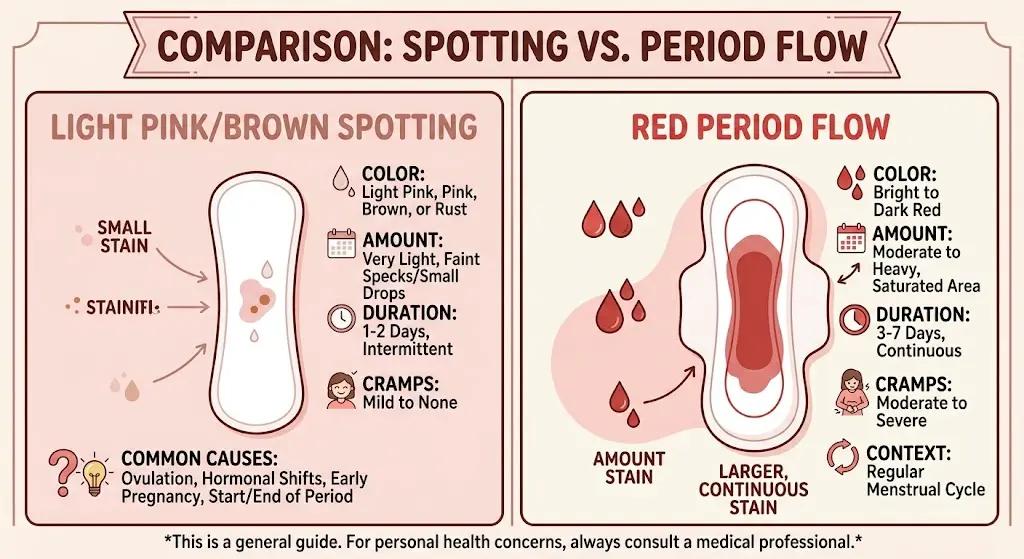
What does implantation bleeding look like? It’s usually a light pink or brown spotting, much lighter than a period, that shows up as a few spots rather than a flow. It shouldn’t soak a pad, rarely comes with clots, and typically clears up within one to three days.
What It Actually Looked Like For Me
I remember checking the calendar three separate times that morning, convinced I’d miscounted my cycle. There was a faint brownish smudge on the tissue, nothing dramatic, nothing that would’ve made me grab a pad on a normal day.
That’s the thing nobody tells you ahead of time. It doesn’t announce itself. It’s easy to dismiss as nothing, or to spiral and assume the worst. Most of the time, it’s neither.
If you’re staring at your underwear right now trying to decide what you’re looking at, you’re not overreacting. This is one of the most Googled early pregnancy questions for a reason, because the signs really can look like the start of your period.
Key takeaway: If the spotting is light, brownish or pink, and doesn’t get heavier over a day or two, it’s far more likely to be implantation bleeding than the start of your period.
Implantation Bleeding vs. Period: Side-by-Side
| Feature | Implantation Bleeding | Period |
|---|---|---|
| Color | Light pink or brown | Bright to dark red |
| Flow | Spotting, doesn’t soak a pad | Starts light, gets heavier |
| Duration | A few hours to 1–3 days | 4–7 days |
| Clots | Rare | Common, especially on heavy days |
| Cramping | Mild or none | Often noticeable |
| Timing | 6–12 days after ovulation | On your expected cycle day |
What Color Should You Expect
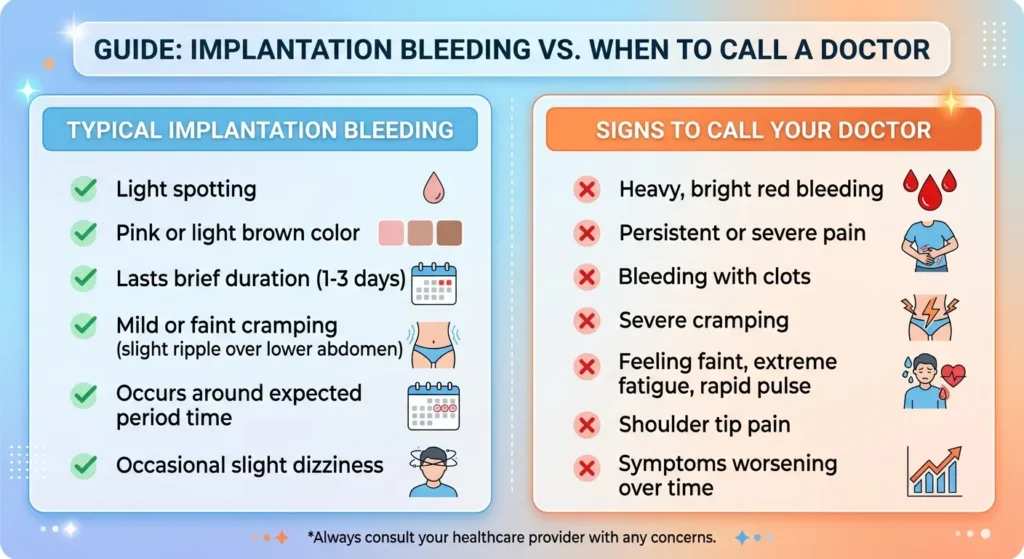
Brown spotting is the most common description, followed by light pink. That brownish shade is simply older blood that took a little longer to make its way out, nothing unusual about it. According to <cite index=”8-1,8-2″>Cleveland Clinic, implantation bleeding is typically brown, dark brown, or pink, light in flow, and shouldn’t soak through a pad</cite>.
Bright red blood is possible in the very early hours, but it usually fades to pink or brown fast. If it stays bright red and picks up in volume, that’s a sign you’re likely looking at your actual period instead.
Timing: When It Shows Up
Most people notice it 6 to 12 days after ovulation, which lines up uncomfortably close to when a period would normally start. That overlap is exactly why so many people mistake one for the other.
This is also where a period calculator earns its keep. If you already know your typical cycle length, spotting that lands well before your expected period date is more likely to be implantation bleeding than an early period. I actually started using the free tool at freeperiodcalculator.com specifically for this, since watching a mystery spot appear a week ahead of schedule was a lot less confusing once I had my dates mapped out. How to track your ovulation window
How Long It Sticks Around
It’s typically short. Think a few hours to about three days, not the four-to-seven-day stretch of a normal period. If bleeding continues well past that window or starts getting heavier by the day, it’s worth treating it as a period or checking in with a provider rather than assuming it’s implantation-related.
Can It Be Red, Heavy, or Clotted
Here’s the honest trade-off nobody likes admitting: not every case fits the textbook description. Some people do see a slightly redder tone, especially early on, and every body handles it a little differently.
That said, heavy bleeding, large clots, or soaking through a pad are not typical signs of implantation bleeding. Those patterns point toward a period, or in some cases something that needs medical attention. Don’t talk yourself into “it’s probably fine” if the bleeding is genuinely heavy.
When to Take a Pregnancy Test
hCG, the hormone home tests detect, only starts building up once implantation is underway. Testing the same day you notice spotting can easily give you a false negative, even if you are pregnant.
Most people get a more reliable read by waiting a few days after the spotting stops, or until the date their period was actually due. Plugging your cycle guessing. Best time to take a pregnancy test after ovulation
When to Call Your Doctor
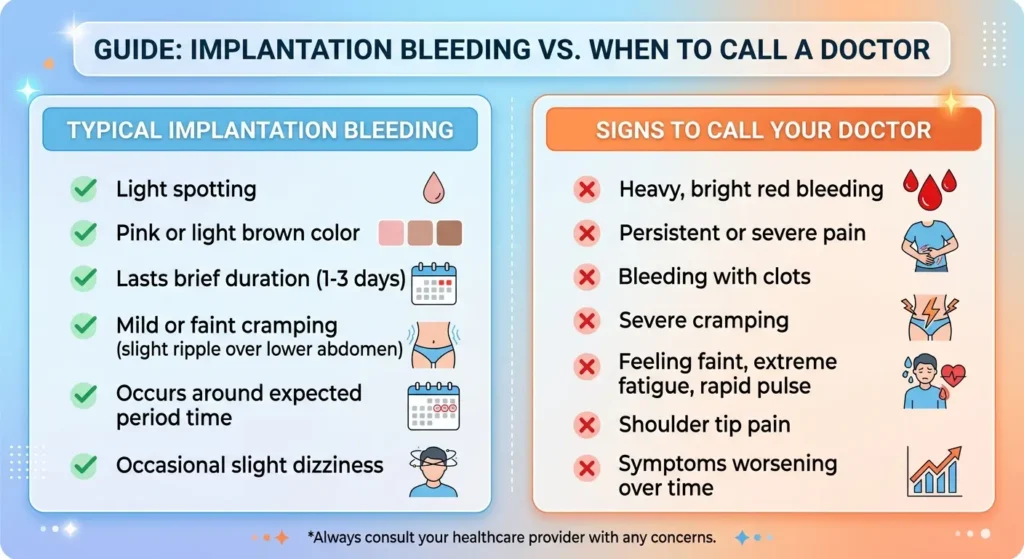
Reach out to your provider if you notice any of the following:
- Bleeding heavy enough to soak a pad
- Bleeding that lasts longer than three days
- Severe or worsening pelvic pain
- Dizziness, fainting, or shoulder pain
- Fever or chills alongside the bleeding
None of these are things to sit on and wait out. They’re worth a same-day call, not a “let’s see how tomorrow goes.”
FAQs
What color is implantation bleeding? It’s usually light pink or brown, not the bright red typical of a period. The brown shade comes from blood that took longer to leave the body.
Can implantation bleeding be bright red? It can start slightly red for some people, but it typically fades quickly to pink or brown. Bright red blood that continues or increases is more likely a period.
How long does implantation bleeding last? Usually anywhere from a few hours to about three days. If spotting continues past that, it’s more likely your period or another cause.
Does implantation bleeding come with cramping? Mild cramping is common and usually milder than typical period cramps. Severe or worsening pain is not a typical sign and should be checked by a doctor.
Can I take a pregnancy test during implantation bleeding? You can, but testing too early can give a false negative since hCG is just starting to build. Waiting a few days, or until your expected period date, usually gives a more accurate result.
When should I worry about implantation bleeding? Worry if bleeding is heavy, lasts more than a few days, or comes with severe pain, dizziness, or fever. Those symptoms warrant a call to your provider rather than waiting it out.
Final Thoughts
Spotting this early in a possible pregnancy is unsettling no matter how many articles you read beforehand. Knowing the general pattern, light, brief, and pink or brown, at least gives you something to compare against instead of guessing blind.
If the timing doesn’t add up or something feels off, a period calculator can help you cut through the confusion by showing you exactly where you are in your cycle. And if anything about the bleeding feels heavier or more painful than described here, trust that instinct and call your doctor.
CTA: Not sure if your dates line up? [Track your cycle with the free period calculator at freeperiodcalculator.com] to see exactly when your period was actually due. Early pregnancy symptoms week by week
Disclaimer: This article is for general informational purposes only and is not a substitute for professional medical advice, diagnosis, or treatment. Always consult your doctor or OB-GYN about any bleeding during pregnancy or if you have concerns about your symptoms.