
So you just found out you’re pregnant or you’re trying to get there. Either way, you’ve probably already heard the words “due date” thrown around like everyone knows exactly how to figure it out.
The truth? Most people don’t. And that’s exactly where a pregnancy wheel becomes your best friend.
Whether you’re using a physical cardboard wheel at your OB’s office or a pregnancy wheel online, this simple tool has been helping expectant parents in the US (and around the world) plan, prepare, and breathe a little easier for decades.
Let’s break down what a pregnancy wheel is, how a period calculator fits into the picture, and why these tools matter more than you might think.
What Is a Pregnancy Wheel, Exactly?
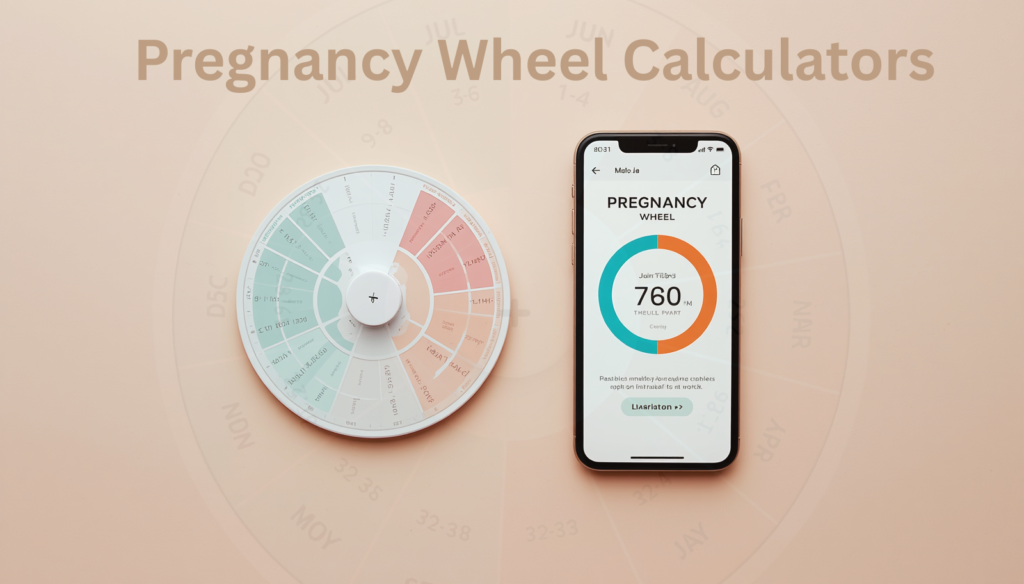
Think of a pregnancy wheel as a circular slide rule designed specifically for pregnancy math. Two rotating discs work together you align your last menstrual period (LMP) with the inner dial, and the outer ring shows you your estimated due date, along with week-by-week milestones.
OB-GYNs and midwives across the US have used physical versions of this tool for over a century. Today, the same logic powers digital pregnancy wheel calculators you can access in seconds online.
At its core, the pregnancy wheel relies on Naegele’s Rule a formula that adds 280 days (40 weeks) to the first day of your last period. That gives you your estimated due date, officially called your EDC (Estimated Date of Confinement) or EDD (Estimated Due Date).
Why Your Period Calculator Is the Starting Point
Here’s something a lot of people don’t realize: pregnancy isn’t counted from conception it’s counted from the first day of your last period.
That’s why a period calculator is step one in the pregnancy timeline. You need that date to feed into the wheel itself. No LMP date? No accurate due date.
For women with regular 28-day cycles, this math is pretty straightforward. But for those with irregular cycles which affects roughly 14–25% of women of reproductive age in the US a digital pregnancy wheel calculator becomes especially valuable. It adjusts based on your actual cycle length, not a one-size-fits-all assumption.
Related: the period calculator on this site makes it easy to pin down the first day of your last period before you spin any pregnancy wheel.
7 Smart Ways a Pregnancy Wheel Changes the Game
1. Pinpoints Your Estimated Due Date in Seconds
The most obvious use and the most important. Plug in your LMP, and a pregnancy wheel online gives you your due date instantly. No math, no confusion.
Keep in mind: only about 5% of babies are born on their exact due date. But knowing that target date helps you and your care team plan everything that follows.
2. Maps Out Your Trimesters Automatically
The wheel divides your 40 weeks into the three trimesters you’ll hear about constantly:
- First Trimester: Weeks 1–13
- Second Trimester: Weeks 14–26
- Third Trimester: Weeks 27–40
Seeing these visually on a wheel (or digital equivalent) makes it easier to understand what’s happening with your body and your baby right now not just in the abstract.
3. Schedules Your Prenatal Appointments
Prenatal care in the US follows a specific schedule. Your provider will likely recommend visits at:
- 8–10 weeks (first OB visit)
- 10–13 weeks (first-trimester screening)
- 18–20 weeks (anatomy scan)
- 24–28 weeks (glucose test)
- 36+ weeks (weekly visits until delivery)
A pregnancy wheel calculator maps these milestones to actual calendar dates, so you know when to call the office before your doctor even tells you.
Related: for a full look at what your body goes through each month, read our guide to common menstrual symptoms.
4. Estimates Your Conception Window
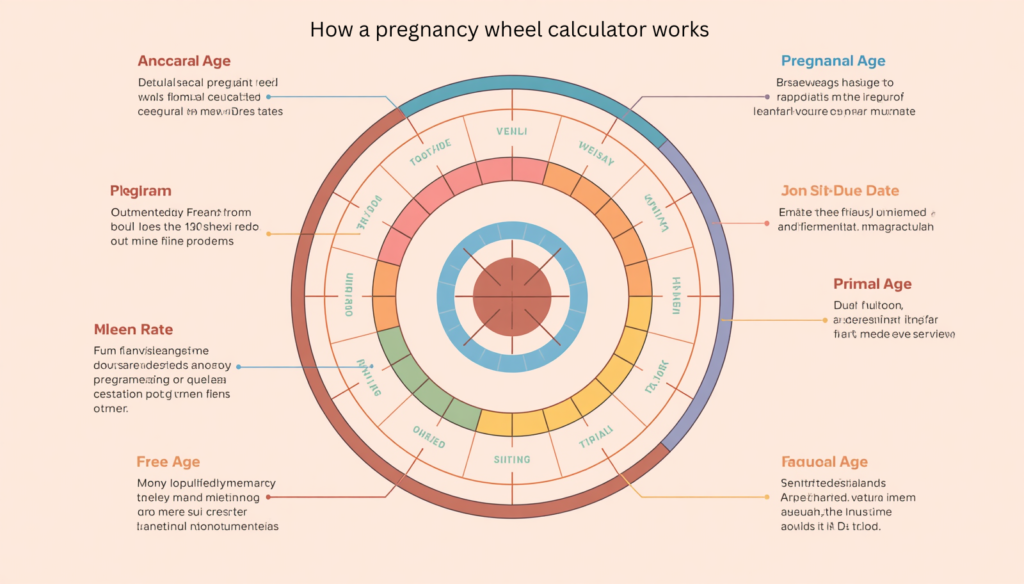
Flip the wheel’s logic in reverse and it becomes a conception estimator. If you know your due date, the wheel calculates back to when conception likely occurred helpful for women tracking ovulation and trying to conceive (TTC).
This is especially useful when used alongside a period calculator to identify your most fertile days each cycle.
5. Tracks Fetal Development Week by Week
Many digital pregnancy wheel calculators go beyond just dates. They overlay developmental milestones when the heartbeat appears, when organs form, when your baby starts kicking onto the timeline.
For first-time parents especially, this context makes the pregnancy feel real and grounding, week by week.
6. Helps Identify Gestational Age from Ultrasound Data
Had an early ultrasound? Your technician measured something called CRL (Crown-Rump Length) to estimate gestational age. Some pregnancy wheel online tools let you enter that measurement and recalculate your due date if it differs from your LMP-based estimate.
This is particularly useful for women who conceived via IVF or who have irregular cycles where LMP alone isn’t a reliable baseline.
7. Supports Conversations With Your Provider
Walk into any OB-GYN or midwifery practice in the US and there’s a wheel sitting on the desk. When you’ve already used one physical or digital you show up prepared. You know what week you’re in. You know what milestones are coming. That makes the conversation richer and faster.
Related: the global period calculator is handy for keeping your dates straight if you’re traveling while pregnant.
Physical Wheel vs. Pregnancy Wheel Online: Which Is Better?
Honestly? Both have their place.
Physical pregnancy wheels are still widely used by healthcare providers because they’re fast, require no internet, and are accurate when used correctly. Some patients even take them home from their first prenatal visit.
Online pregnancy wheel calculators and apps are where most US users do their calculating today. They’re accessible 24/7, adjust for irregular cycles, and often include extra features like:
- Week-by-week email reminders
- Baby size comparisons (your baby is the size of a mango!)
- Symptom trackers
- Kick count logs
If you’re early in your pregnancy or still TTC, a pregnancy wheel online is a no-brainer starting point free, instant, and surprisingly accurate.
How Accurate Is a Pregnancy Wheel Calculator?
This is the question everyone asks and the honest answer is: pretty accurate, but not perfect.
The standard wheel assumes a 28-day cycle with ovulation on Day 14. For women who fit that profile, accuracy is solid. But research shows that actual ovulation can vary significantly from cycle to cycle, even in women with “regular” periods.
That’s why your provider may adjust your due date after an early ultrasound (before 13 weeks), which is the most accurate way to date a pregnancy. The wheel gives you a great starting estimate. The ultrasound fine-tunes it.
Bottom line: use the wheel to get oriented, then let your provider confirm the details.
Quick Tips for Using a Period Calculator Accurately
To get the most out of any wheel or period calculator, keep these in mind:
- Use the first day of your last full period not spotting, not the day it ended.
- Know your average cycle length the default is 28 days, but plug in your real number if you know it.
- Track for at least 2–3 cycles before TTC so you have a reliable baseline.
- Note irregularities stress, illness, and major weight changes can shift ovulation.
- Sync with your OB’s dating if your ultrasound date differs by more than a week, ask about adjusting your official due date.
How to Read a Pregnancy Wheel Like a Pro
Using one of these tools for the first time can feel slightly intimidating, but the mechanics are simpler than they look. On a physical wheel, you’ll find an inner disc with the months of the year and an outer ring marked in weeks. You rotate the inner disc until the first day of your last period lines up with the indicator, and the outer ring immediately shows your estimated due date plus where you are in your pregnancy right now.
On a digital version, you simply type your last period date and average cycle length, and the tool does the same rotation invisibly. Both approaches rely on the same Naegele’s Rule math, so a well-built online tool and a carefully used cardboard wheel give you the same result within a day.
The one habit that helps most people: double-check your inputs. A single wrong digit for your last period date shifts everything by a month. Read the date off your calendar or period tracker, not from memory, and you’ll avoid the most common source of error.
If your provider hands you a physical wheel during your first visit, ask them to walk you through it once. Thirty seconds of guidance is usually enough to make the paper version feel just as natural as an app. Many people keep both handy, one on the fridge and one on their phone, so the date is never more than an arm’s reach away when a question comes up between appointments.
Common Misconceptions About Due Dates
There are a few beliefs about due dates that cause more stress than they should. The first is the idea that your due date is a deadline. In reality, a due date is a midpoint, and full-term pregnancies routinely range from a week before to two weeks after the estimate. Your provider cares about a healthy range, not a single magic day.
The second misconception is that a longer or shorter cycle means your due date math is wrong. It simply needs adjusting. The standard rule assumes a 28-day cycle, so if your cycles run 32 days, the tool should add the difference when estimating ovulation and the due date. Digital tools handle this automatically; paper wheels sometimes don’t, which is why a digital version is worth using if you have an irregular pattern.
Finally, many people believe that conception happened at ovulation when, technically, sperm can meet the egg up to five days later. The difference rarely matters for your due date, but it explains why “conception week” can feel fuzzy. None of this makes the tool wrong, it just means every pregnancy has a small window of uncertainty around it.
Planning Around Your Estimated Due Date
Once you have your estimate, you can put it to work immediately. Mark the date on your calendar, then count backward to plan maternity leave, childcare, and travel. Many parents also use the timeline to schedule the big-ticket items, like the anatomy scan around week 20 and the glucose screening near week 28, without relying on your provider to remind you.
Your estimate also helps you prepare financially. Knowing roughly when your baby is due lets you plan health insurance changes, open the right benefits windows, and set aside time off well in advance. None of this is urgent the week you get a positive test, but having the date early means you never scramble later.
And if you’re still trying to conceive, the same tool is useful in reverse. Combine your estimated dates with our period calculator to spot your fertile window each cycle, which turns a wheel into a planning partner before pregnancy even begins.
Using Your Due Date at Every Stage
Your estimated due date stays useful from the very first weeks all the way to delivery, and it helps to know how it changes as your pregnancy progresses. Early on, the date is built purely from your last period. After your first ultrasound, usually between weeks 8 and 13, your provider may refine the date using the baby’s measurements, which is the most accurate method available.
In the middle months, the date anchors your screening schedule. Blood tests, the anatomy scan, and the glucose test are all timed against your gestational age, so keeping the date handy means fewer surprises when your care team books appointments.
Near the end, the date shifts from a planning tool to a conversation starter. As you approach week 39 and beyond, your provider will discuss signs of labor, when to call, and how to handle a pregnancy that runs a little past the estimate. Around 5% of babies arrive exactly on their due date, so thinking of it as a target range rather than a promise keeps expectations realistic and stress low.
One more thing the early estimate makes easier is scheduling. Knowing your due date at week 4 means you can book a summer vacation, arrange pet care, and brief your employer months in advance, all while the baby is still the size of a sesame seed. A little planning now turns the final weeks into calm anticipation instead of last-minute chaos.
Through every stage, the underlying math stays the same, which is why it pays to get your starting date right. If you’re ever unsure, our global period calculator helps you confirm your cycle dates quickly, and the period calculator gives you the same LMP baseline any provider will ask for.
FAQ: Pregnancy Wheel & Period Calculator

What is a pregnancy wheel used for?
A pregnancy wheel is a tool physical or digital that calculates your estimated due date based on the first day of your last menstrual period (LMP). It also maps out trimester milestones, prenatal appointment windows, and fetal development stages across your 40-week pregnancy.
How does a period calculator help during pregnancy?
A period calculator helps you identify the first day of your last menstrual period, which is the starting point for all pregnancy dating. Without that date, the pregnancy wheel can’t give you an accurate due date or gestational age.
Is a pregnancy wheel online as accurate as one at the doctor’s office?
Yes both use the same underlying formula (Naegele’s Rule). Digital versions may actually be more flexible because they allow you to adjust for non-standard cycle lengths, which paper wheels typically don’t.
Can I use a pregnancy wheel calculator if my cycle is irregular?
You can, and many online tools are designed specifically to accommodate irregular cycles. That said, an early ultrasound (before 13 weeks) is the most reliable way to establish gestational age when cycles are unpredictable.
When should I use a pregnancy wheel before or after seeing a doctor?
Both. Use a pregnancy wheel online the moment you suspect you might be pregnant to get oriented and ask informed questions. Then let your provider confirm your due date with a clinical exam and ultrasound.
The Bottom Line: Your Pregnancy Journey Starts With the Right Tools
A pregnancy wheel isn’t just a relic from your grandmother’s OB’s office. It’s a deceptively simple tool that anchors your entire prenatal journey from that first positive test all the way to your baby’s birth.
Pair it with a period calculator to nail down your LMP, and you’ve got a clear, week-by-week roadmap before you even step into your first appointment.
Whether you’re trying to conceive, just found out you’re pregnant, or are already deep into your third trimester, a pregnancy wheel online can give you clarity, calm, and confidence all for free, in under a minute.
Ready to get started? Try our free pregnancy wheel calculator and get your estimated due date right now. No sign-up required.
Medical disclaimer: This article is for informational purposes only and does not constitute medical advice. Always consult with a qualified healthcare provider regarding your pregnancy and prenatal care.